
Western Cape dam levels were about 5% lower than the same period in 2025 by early September 2026, with provincial storage at 79.73% on 1 September and the Cape Town water supply system at 75.81%, according to reports from IOL’s Cape Argus and NovaNews. The City of Cape Town’s own dam-level dashboard confirmed combined storage at 75.7% on 2 September 2026, marking a slight but steady week-on-week decline.
The provincial figure of 79.73% on 1 September was down marginally from 79.78% the previous week, while the Cape Town system dropped from 76.31% to 75.81% over the same period, NovaNews reported. Eyewitness News had already flagged the downward trend on 28 August 2026, noting that overall provincial storage had fallen from 80.1% to 79.7%.
Premier Alan Winde, speaking to the Cape Argus on 1 September 2026, said the province had learned hard lessons from past droughts and climate pressures. The Western Cape has learned difficult lessons over the past several months and years; we must all always be prepared for the pressures of climate change and associated risks,” Winde said.
The Western Cape government has set aside more than R65 million for water resilience measures in the 2026/27 financial year, the Cape Argus reported. The funding comes as authorities brace for a hotter, drier summer potentially shaped by El Niño conditions, though precise forecasts for the phenomenon’s timing and severity remain unconfirmed by multiple independent sources.
Despite the year-on-year decline, the City of Cape Town’s water dashboard showed no formal water restrictions in place as of early September 2026. Restrictions have not been in effect since November 2020, following the end of the severe 2015–2018 drought that pushed Cape Town to the brink of “Day Zero.
Anton Bredell, Western Cape Minister of Local Government, Environmental Affairs and Development Planning, warned that readiness could not wait for crises to arrive. “Preparedness cannot begin when the first major wildfire breaks out, or when water systems come under pressure, or when a prolonged heatwave starts affecting vulnerable communities,” Bredell told the Cape Argus.
The current readings, while lower than 2025, remain well above crisis levels — during the worst of the 2017 drought, provincial dam storage fell below 30%. However, the consistent downward trend across multiple monitoring points signals that residents across Cape Town and the wider Western Cape should treat water conservation as an ongoing priority rather than a reactive measure.
The exact province-wide year-on-year gap of 5% is reported by several outlets but has not been directly confirmed by the City of Cape Town dashboard. Cape Flats News will check with the Department of Water and Sanitation for verified year-on-year comparative figures and will update this story by 10 September 2026.
Watern Cape Dam Levels Update
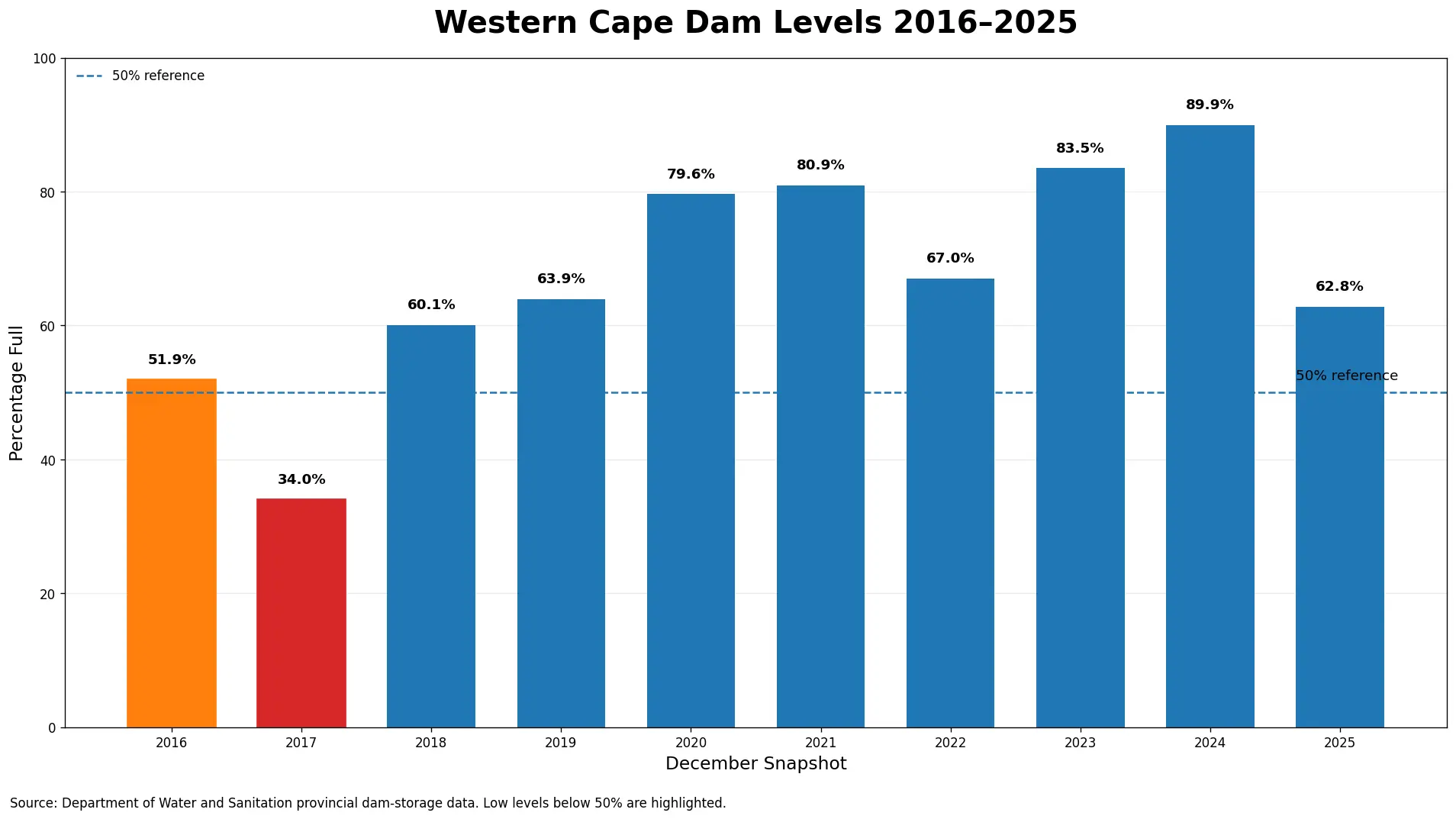
As of the latest available figures, 4 September 2026, the Western Cape’s major dam system is still in a reasonably strong position, but it is well below last year’s levels.
Current Western Cape levels
The Western Cape’s overall dam storage was about 79.7% at the latest weekly reading, down marginally from 79.78% the previous week.
For the Cape Town Water Supply System, the latest daily reading on 4 September 2026 was 75.9%.
The important warning
The overall percentage looks healthy, but the year-on-year comparison is much less comfortable. The Cape Town system was around 92.5% at the same point last year, compared with 75.9% now, meaning storage is roughly 16.6 percentage points lower than a year ago.
The biggest concern among the six main Cape Town dams is currently Steenbras Lower at 49.5%, followed by Voëlvlei at 59.7%. Theewaterskloof, which is by far the largest dam in the system, is at 76.5%.
Western Cape dams remain relatively well stocked at around 80%, but storage is significantly below last year’s levels as the province enters the drier summer period.