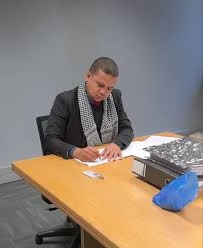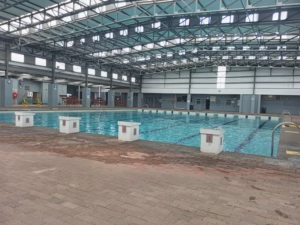
The long running legal battle between Wesley Neumann and the Western Cape Education Department has formally come to an end following a decisive Labour Court ruling that reinstates him as principal of Heathfield High School. The judgment brings closure to a dispute rooted in the earliest and most uncertain period of the Covid Nineteen pandemic, a time marked by fear confusion and rapidly changing government directives across the education sector.
Acting Judge de Kock ruled that Neumann’s dismissal was inappropriate and disproportionate, setting it aside and replacing it with a final written warning. The decision restores Neumann to his former position and marks a significant intervention by the court in a case that has spanned several years and multiple legal forums, raising serious questions about fairness governance and proportionality in disciplinary action.
Origins Of A Conflict During A National Crisis
The dispute dates back to the first wave of the Covid19 pandemic when schools across the country faced mounting pressure to reopen amid rising infection rates and widespread anxiety among staff parents and learners. Neumann refused to reopen Heathfield High School at that time, citing safety concerns and what he believed to be inadequate protections for the school community.
This decision placed him at odds with directives issued by the then head of the department Brian Schreuder. The Western Cape Education Department subsequently charged Neumann with misconduct, alleging that he had defied lawful instructions. Disciplinary proceedings began later that year, setting in motion a process that would ultimately cost the department significant time resources and public scrutiny.
Disciplinary Findings And A Rejected Compromise
The internal disciplinary process culminated in a finding of guilt on multiple misconduct charges, after which the department offered Neumann an alternative to dismissal. He was presented with the option of accepting a demotion to a head of department post at one of several schools, an offer that would have effectively ended the dispute without further litigation.
Neumann rejected the proposal and elected instead to challenge the outcome through the available legal channels. He maintained that his actions were motivated by concern for health and safety rather than defiance, and that the disciplinary measures imposed were excessive under the circumstances. This decision prolonged the matter and carried it into the Education Labour Relations Council and ultimately the Labour Court.
Conflicting Legal Outcomes And A Final Intervention
In a previous ruling the Education Labour Relations Council found that Neumann’s dismissal was appropriate, a conclusion that appeared to validate the department’s handling of the matter. Neumann then approached the Labour Court on review, arguing that the findings and sanction failed to properly account for the context in which his decisions were made.
The Labour Court partly agreed, overturning several of the earlier findings while upholding one charge relating to the tone of written correspondence sent to the head of department. The court found that the language used was disrespectful and amounted to insolence, but ruled that dismissal was not a justified response.
Department Weighs Its Options After Judgment
Following the ruling the Western Cape Education Department confirmed that it is considering its next steps. Spokesperson Bronagh Hammond said the department’s legal team is reviewing the judgment in detail before deciding whether to appeal, indicating that the matter may not yet be entirely closed.
While the Labour Court overturned some of the previous findings, it upheld one of the charges, namely that the language used by Mr Neumann in written correspondence to the Head of Department was disrespectful and amounted to insolence. However, the acting Judge reduced the dismissal to a final written warning. This is but one aspect of the ruling that is being carefully considered.
Political Reaction And Claims Of Persecution
The ruling was welcomed by the GOOD Party, which has consistently framed the case as an example of political hostility rather than legitimate disciplinary enforcement. Party secretary Brett Herron described the outcome as a victory for justice and accountable governance, arguing that the case should never have progressed as far as it did.
Neumann is not only an experienced and respected educator, but also a duly elected City of Cape Town councillor for the GOOD Party. From the outset, GOOD has maintained that the actions taken against him were neither fair nor lawful and were driven by political hostility rather than any legitimate concern about his performance or integrity. This case stands as a damning indictment of the WCED and the political leadership that chose to pursue a personal and losing legal battle at enormous cost to the public.