
The United States has announced a sweeping withdrawal from dozens of international organisations, marking one of the most aggressive retreats from global cooperation in modern American history. The decision reflects a hardening stance by Washington against multilateral institutions it claims no longer align with national priorities.
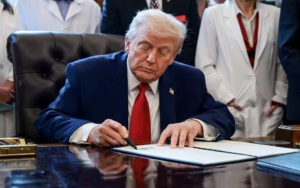
The move was confirmed after President Donald Trump approved a memorandum suspending support for 66 international bodies. According to the White House, the targeted organisations operate in ways that undermine US sovereignty, economic interests, and national security, placing global agendas above domestic concerns.
United Nations Agencies Among The Hardest Hit
Nearly half of the organisations affected are part of the United Nations system, underscoring the administration’s deepening distrust of UN led governance. One of the most significant withdrawals is from the UN Framework Convention on Climate Change, the central platform for international climate negotiations.
Other affected UN agencies include UN Women, which focuses on gender equality initiatives, and the United Nations Population Fund, a key body dealing with population and demographic policy. The administration argues that these agencies promote ideological programmes that conflict with US policy direction and impose obligations viewed as ineffective.
Climate And Energy Bodies Lose US Backing
Outside the United Nations, several influential climate and energy institutions have also lost US participation. These include the Intergovernmental Panel on Climate Change, widely regarded as the leading authority on climate science, and the International Renewable Energy Agency, which promotes global clean energy development.
The administration maintains that these bodies push radical climate policies that threaten economic growth and energy independence. Supporters of the move argue that disengagement allows Washington to pursue environmental strategies on its own terms, without international constraints.
Security And Governance Forums Also Targeted
The withdrawals extend beyond climate and social policy. International forums focused on security and governance have also been affected, including the Global Counterterrorism Forum, which facilitates cooperation against violent extremism.
Critics warn that stepping away from such platforms could weaken intelligence sharing and coordinated responses to global threats. They argue that international security challenges rarely respect national borders and require sustained collaboration.
Administration Frames Decision As Sovereignty Protection
US Secretary of State Marco Rubio defended the decision, arguing that many of the organisations actively seek to constrain American decision making. He framed the withdrawals as a necessary measure to protect national autonomy and ensure accountability for taxpayer funds.
No more sending American taxpayers’ money abroad with little to show for it
Rubio indicated that the administration will continue reviewing other international commitments, suggesting that further withdrawals remain possible.
Critics Condemn Retreat From Global Leadership
The response from policy experts and former officials has been sharply critical. Many view the move as a dangerous erosion of global cooperation at a time of growing climate, health, and security crises.
This is shortsighted, embarrassing, and foolish
Opponents argue that abandoning international frameworks diminishes US influence and allows rival powers to fill the vacuum left by Washington’s absence.
A Pattern Of Strategic Disengagement
The latest withdrawals follow earlier exits from the Paris climate agreement, the World Health Organization, and UNESCO, as well as funding cuts to UN humanitarian agencies. Together, these actions reflect a broader foreign policy strategy focused on disengagement from multilateral oversight.
Republican lawmakers have also pushed for a complete withdrawal from the United Nations itself, claiming the institution no longer serves American interests. While President Trump has repeatedly criticised the UN, no formal decision on full withdrawal has been announced.
Scale Of The Withdrawals
The scope of the decision is unprecedented in recent decades, affecting institutions across climate science, social policy, security, and governance. Supporters argue it restores control and fiscal discipline, while critics warn of long term diplomatic and strategic consequences.
The table below outlines the scale of the announced withdrawals.
| Category | Number Of Organisations |
|---|---|
| Total International Bodies Affected | 66 |
| United Nations Related Entities | Approximately Half |
| Non United Nations Bodies | Approximately Half |
International Bodies Affected By US Withdrawal
| Organisation Name | Type | Primary Focus Area |
|---|---|---|
| United Nations Framework Convention on Climate Change | United Nations Body | Global climate negotiations and environmental policy coordination |
| UN Women | United Nations Body | Gender equality and women empowerment initiatives |
| United Nations Population Fund | United Nations Body | Population studies, reproductive health, and demographic research |
| United Nations Relief and Works Agency | United Nations Body | Humanitarian assistance to Palestinian refugees |
| Intergovernmental Panel on Climate Change | International Scientific Body | Assessment of climate science and climate related risks |
| International Renewable Energy Agency | International Energy Body | Promotion of renewable energy adoption and policy development |
| Global Counterterrorism Forum | International Security Forum | International cooperation against terrorism and violent extremism |
| World Health Organization | United Nations Body | Global public health coordination and disease response |
| United Nations Educational Scientific and Cultural Organization | United Nations Body | Education, science, culture, and heritage protection |
| Paris Climate Agreement | International Treaty Framework | Global climate mitigation and emissions reduction commitments |