Ugandans went to the polls in an atmosphere thick with tension, uncertainty and historic consequence as the East African nation embarked on one of its most closely watched elections in decades. From the early hours of the morning, long queues formed at polling stations across the country, with voters arriving before sunrise in what many described as a quiet act of defiance and civic resolve. The election, choosing both a president and members of parliament, has unfolded under intense domestic and international scrutiny.
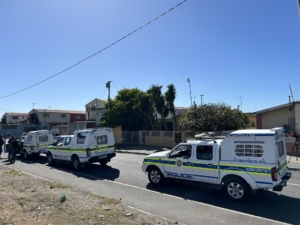
The government imposed a nationwide internet shutdown as voting began, citing security concerns, a move that immediately heightened fears over transparency and accountability. Thousands of security personnel were deployed across urban and rural areas, transforming public spaces into zones of visible state authority. Officials insisted the measures were preventive and aimed at ensuring peace, yet critics argued that the scale of security presence underscored the fragility of the political moment.
Technical Delays And Public Frustration
Voting did not proceed smoothly in all areas, with technical difficulties reported at several polling stations. Biometric voter verification kits malfunctioned in some locations, causing delays that tested the patience of voters who had already waited for hours. Election officials acknowledged the problems and assured the public that corrective steps were being taken to preserve the credibility of the process.
The Electoral Commission issued a statement expressing regret over the disruptions and appealed for calm, emphasising its commitment to a free and fair election. For many Ugandans, however, these delays revived memories of previous elections where logistical failures were cited by opposition figures as evidence of systemic bias and administrative manipulation.
Long Rule And Rising Challenge
At the centre of the election stands President Yoweri Museveni, seeking yet another term after nearly four decades in power. Having ruled since 1986, he is among the world’s longest serving leaders and has shaped Uganda’s political landscape in profound and often controversial ways. Supporters credit him with stability and economic development, while critics accuse him of entrenching authoritarian rule.
Challenging him is a diverse field of opponents, most notably Robert Kyagulanyi, widely known as Bobi Wine, a former musician turned politician whose appeal among younger voters has transformed the opposition movement. At 43 years old, Wine has positioned himself as a symbol of generational change, drawing massive crowds during the campaign despite repeated clashes with security forces.
Security Warnings And Political Rhetoric
As tensions escalated ahead of polling day, police officials warned against what they described as criminal acts disguised as political expression. The language of security dominated official messaging, reflecting deep anxieties within the state about potential unrest. Authorities framed the heavy deployment as a safeguard for national stability.
Wine, meanwhile, issued a stark warning of his own, threatening mass protests should the election be manipulated.
“Violent regimes get thrown out by protests.”
The president responded with an equally forceful message, cautioning that anyone seeking to incite violence would face severe consequences.
“Anyone who attempts to incite violence will be dealt with firmly.”
Past Results And Lingering Disputes
The shadow of the 2021 election looms large over the current vote. In that contest, Museveni secured victory with 59 percent of the vote, while Wine obtained 35 percent, a result that sparked widespread allegations of rigging. The post election period was marked by unrest, arrests and the placement of Wine under house arrest, actions justified by the state on national security grounds.
Those events deepened political polarisation and eroded trust in electoral institutions. For many voters, Thursday’s election is not only about choosing leaders but about determining whether Uganda can move beyond a cycle of disputed outcomes and political repression.
Numbers That Define The Stakes
The scale of the election reflects its national significance, with millions of Ugandans registered to vote. These figures highlight both the breadth of participation and the magnitude of the responsibility resting on electoral authorities. Turnout and final tallies will be closely examined as indicators of legitimacy.
Below is a summary of key electoral statistics that frame the current contest and its historical context.
| Indicator | Figure |
|---|---|
| Registered Voters | 21.6 Million |
| Museveni Vote Share 2021 | 59 Percent |
| Bobi Wine Vote Share 2021 | 35 Percent |
| Museveni Years In Power | Since 1986 |