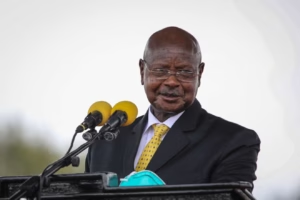
Saif al Islam Gaddafi, the son of Libya’s former leader Muammar Gaddafi, has been assassinated in an attack that has sent shockwaves through a country still haunted by its unresolved past. A source close to the family confirmed his death, describing a sudden and violent act carried out at a place that had offered him rare privacy and concealment after years in the shadows.
According to the account provided to Al Arabiya, the killing unfolded swiftly and with chilling precision.
He was killed by four people who quickly fled the scene after shooting him in his garden
the family source said. The attack, carried out by multiple assailants who escaped immediately, has deepened fears about the persistent lawlessness that continues to define Libya’s fragile security landscape.
🚨MUAMMAR GADDAFI’S SON SAIF AL-ISLAM GADDAFI ASSASSINATED
Who did it? Our sources on the ground in Libya told us that they suspect that British intelligence used local proxies to assassinate the man seen by many as the one who could reunite Libya, 15 years after NATO bombed… pic.twitter.com/Bn0cUGTGmm
— Afshin Rattansi (@afshinrattansi) February 3, 2026
Life In Hiding After A Fallen Regime
For several years prior to his death, Saif al Islam Gaddafi had reportedly been living in hiding inside Libya, moving discreetly and avoiding public exposure. His existence had become emblematic of the unresolved chapter left behind after the dramatic collapse of his father’s rule and the violent upheaval that followed.
Once viewed by some supporters of the former regime as a potential bridge between old power structures and a future settlement, his life instead became marked by isolation and danger. The secrecy surrounding his whereabouts reflected the enduring hostility he faced from rivals and victims of the former government, as well as the fractured authority of the Libyan state.
Crimes Charges And A Death Sentence
Saif al Islam’s name remained closely tied to the bloody events of 2011, when mass protests erupted against his father’s rule and were met with a violent crackdown. In 2015, a Libyan court sentenced him to death for his role in those events, a verdict that carried heavy symbolic weight in a country seeking accountability after decades of authoritarian rule.
International scrutiny followed alongside domestic proceedings. The International Criminal Court charged him separately with crimes against humanity, reinforcing his status as one of the most prominent figures associated with alleged abuses during the uprising. These legal actions ensured that his legacy would be defined as much by the courtroom as by his lineage.
Amnesty And A Controversial Return
Despite the severity of the charges against him, Saif al Islam was released in 2017 under a general amnesty declared by authorities aligned with eastern Libya. The move sparked outrage among many Libyans who viewed it as a betrayal of justice, while others saw it as a pragmatic step in a deeply divided nation.
His release reopened old wounds and revived speculation about his political ambitions. It also highlighted the fragmented nature of Libya’s institutions, where competing authorities issued contradictory rulings and amnesties, often undermining the credibility of the justice system in the eyes of the public.
Failed Bid For The Presidency
In 2021, Saif al Islam re emerged dramatically onto the national stage by registering as a candidate for the presidency. His bid was met with fierce opposition, legal challenges, and disbelief from those who associated his name with repression and violence.
The planned December election never took place, collapsing amid political deadlock and disputes over eligibility and authority. His aborted candidacy became another symbol of Libya’s inability to move forward with a unified political process, while his continued survival at the time underscored how unresolved the country’s post revolution settlement remained.
A Nation Still Trapped In Conflict
Muammar Gaddafi’s seizure of power in a 1969 coup set Libya on a path of centralized rule that lasted more than four decades, ending only with his killing in 2011 by insurgents backed by a US led military intervention. The fall of his government promised change but delivered prolonged instability.
Since then, Libya has endured intermittent civil war and remains divided between rival administrations in the west and east. Presidential and parliamentary elections have been repeatedly postponed as political tensions persist, leaving many Libyans fearful that the violent death of Saif al Islam Gaddafi is yet another sign that the country remains unable to escape the shadows of its past.