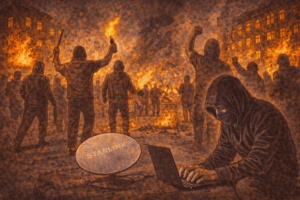
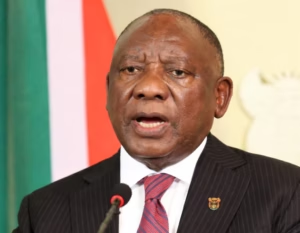
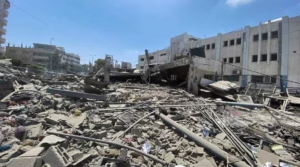
Fresh revelations from the United States have intensified an already volatile geopolitical dispute after reports emerged that thousands of Starlink satellite internet terminals were secretly delivered into Iran during a period of nationwide turmoil. According to the Wall Street Journal, approximately 6,000 units were smuggled into the country earlier this year at the height of civil unrest. Senior American officials reportedly confirmed that funding for the operation flowed through the US State Department, raising immediate questions about the depth of Washington’s involvement in Iran’s internal crisis.
The reported deliveries coincided with a sweeping internet blackout imposed by Iranian authorities in January, a move Tehran described as necessary to contain unrest. While US officials indicated that President Donald Trump was aware of the transfers, it remains unclear whether he personally authorised the plan. The covert deployment appears to substantiate long standing accusations from Tehran that foreign actors were actively interfering in domestic instability during a period marked by bloodshed and escalating violence.
Unrest Turns Deadly
The protests initially erupted in December as demonstrations over worsening economic hardship. Inflation, currency collapse and prolonged sanctions pressure had already strained the livelihoods of ordinary Iranians. What began as peaceful gatherings, however, rapidly escalated into confrontations that authorities described as organised and violent. Iranian officials have alleged that the unrest was exploited by hostile foreign interests intent on destabilising the state.
Foreign Minister Abbas Araghchi claimed that more than 3,000 people were killed during the disturbances, including nearly 700 individuals he labelled as terrorists, alongside civilians and members of the security forces. The scale of the casualties reflects one of the most violent internal episodes in recent Iranian history, and the political fallout continues to reverberate across the region as competing narratives over responsibility gain traction.
Tehran Alleges Foreign Sabotage
President Masoud Pezeshkian has accused the United States and Israel of embedding what he termed foreign terrorists among protest crowds. Iranian authorities argue that the violence bore hallmarks of coordinated sabotage rather than spontaneous civic dissent. A diplomatic source cited by Iranian state aligned media alleged that attackers used what were described as ISIS like tactics, including beheadings of law enforcement officers and civilians being burned alive.
The accusations mark a dramatic escalation in rhetoric between Tehran and Washington. Iranian officials maintain that the pattern of violence pointed to infiltration rather than organic protest, asserting that digital tools and satellite connectivity played a pivotal role in sustaining coordination during the blackout. The alleged Starlink deployment now forms a central pillar of that claim, feeding a broader narrative of engineered destabilisation.
Trump Signals Support
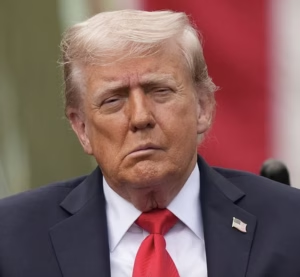
During the height of the unrest, President Trump publicly voiced encouragement for demonstrators. On his Truth Social platform he wrote,
All Iranian patriots, keep protesting. Take over your institutions if possible.
The statement was interpreted by Iranian leaders as direct endorsement of regime change, further inflaming tensions between the two capitals.
Trump also declared that
help is on its way
and announced the deployment of what he described as a
beautiful armada
to the region. While no military intervention materialised, the language intensified speculation of imminent escalation. Tehran viewed these remarks as confirmation of hostile intent, especially against the backdrop of reported technological support reaching Iranian soil.
Digital Tools And Sanctions Pressure
The US State Department has long funded internet access initiatives aimed at bypassing censorship in restrictive environments. Officials familiar with the matter reportedly indicated that funds were redirected from virtual private network programmes to facilitate the acquisition of Starlink terminals. Previous digital support initiatives were said to have allowed between 20 million and 30 million Iranians to remain online during earlier unrest and regional conflict.
The developments unfold amid Washington’s continued efforts to pressure Tehran into accepting a revised nuclear agreement. After withdrawing from the 2015 Joint Comprehensive Plan of Action during his first term, Trump reinstated sanctions under what became known as a maximum pressure campaign. Iranian officials argue that decades of economic sanctions, which have positioned Iran among the most sanctioned nations globally, have severely damaged the economy and contributed directly to public frustration that ignited the protests.
Global Fallout And Rising Stakes
Moscow has characterised the alleged operation as part of a broader attempt to destabilise the Iranian state using a colour revolution model. Russian officials contend that the pattern mirrors tactics seen in other geopolitical flashpoints where digital infrastructure, civil unrest and external messaging campaigns intersect. The claim adds another layer to an already complex web of rivalries spanning Washington, Tehran and Tel Aviv.
Despite public denials from the Trump administration regarding direct orchestration of anti government riots, the reported Starlink deliveries point to expanded covert engagement during a moment of acute vulnerability for Iran. The political consequences of these disclosures are likely to shape diplomatic calculations across the Middle East, as questions persist about sovereignty, intervention and the invisible frontiers of digital warfare.
Starlink Sparks Sovereignty Crisis Across Global Battlefields
Starlink has increasingly emerged as more than a commercial satellite internet service, finding application in conflict zones where conventional communications infrastructure has collapsed or been deliberately targeted. In theatres such as Ukraine, satellite terminals have enabled battlefield coordination, drone operations and real time intelligence sharing when terrestrial networks were disrupted. While proponents frame this as support for connectivity and resilience, critics argue that the deployment of privately controlled satellite infrastructure into sovereign territory during conflict can materially alter the balance of power. The ability to bypass state telecommunications controls provides opposition movements, armed groups or foreign backed actors with a secure channel beyond the reach of domestic regulators, effectively shifting information dominance away from the host government.
The security implications are significant. When an external power facilitates the covert introduction of satellite communication systems into another country, it may undermine national sovereignty, compromise intelligence operations and weaken lawful security enforcement during periods of unrest. Governments rely on control of critical communications infrastructure to manage emergencies, prevent coordinated violence and protect sensitive state data. Unauthorised satellite networks can create blind spots for counter terrorism operations, enable encrypted coordination beyond domestic interception capabilities and open pathways for cyber exploitation. In volatile environments, such breaches can escalate tensions, entrench instability and deepen mistrust between states, particularly where foreign involvement is perceived as an attempt to engineer political outcomes rather than simply provide connectivity.