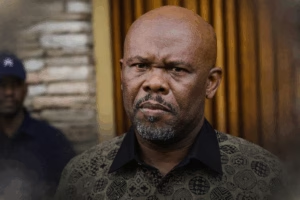
Pressure is mounting on President Cyril Ramaphosa to take decisive action against Police Minister Senzo Mchunu, as civil society groups and political analysts question why the minister remains on special leave with full pay and benefits. The criticism follows Ramaphosa’s announcement that action would be taken against several government officials implicated in the Madlanga Commission of Inquiry, an announcement that conspicuously excluded Mchunu despite serious allegations surrounding his conduct.
The Organisation Undoing Tax Abuse has been particularly vocal, arguing that the continued suspension arrangement places an unnecessary burden on taxpayers while eroding confidence in executive accountability. The group contends that leadership in a deeply troubled police service requires moral authority and decisive discipline, qualities that are undermined when a minister facing grave allegations continues to draw a public salary.
OUTA Accuses Presidency Of Avoiding Accountability
OUTA has framed the issue as one of political will rather than legal complexity, insisting that sufficient grounds already exist for dismissal. The organisation argues that interference in operational policing matters alone constitutes a breach serious enough to warrant removal from office, regardless of the commission’s final findings.
“The president must make a decision because he cannot keep him on paid leave all the time,” said OUTA Chief Executive Officer Wayne Duvenage.
Duvenage warned that waiting for the commission’s final report risks creating a damaging perception that the president is shielding an ally. He described the police service as an institution in urgent need of firm leadership, adding that lingering doubts around the minister’s conduct weaken efforts to restore integrity and public trust.
The Commission And The Silence Around Mchunu
The Madlanga Commission of Inquiry, chaired by retired Constitutional Court Justice Mbuyiseli Madlanga with the assistance of senior advocates, is investigating allegations of criminality, corruption, and political interference within the criminal justice system. Established by Ramaphosa in July 2025, the commission has already produced an interim report and has since had its deadline extended to the end of June.
Following the submission of the interim report, Ramaphosa announced that several current and former officials would face criminal investigation after prima facie evidence of wrongdoing was identified. However, the omission of Mchunu from this list has drawn sharp criticism, particularly as the president directed a special investigations task team to be formed without clarifying what consequences, if any, the minister might face.
Presidency Defends A Cautious Constitutional Approach
The Presidency has pushed back against claims of inaction, arguing that constitutional principles require fairness and due process for anyone facing allegations. Ramaphosa’s spokesperson has maintained that the president will act when the appropriate time comes, once the commission has completed its work and made definitive findings.
“You can hold the view that he must act now, he holds the view that he would act once the commission has concluded its work because he believes that Minister Mchunu must answer to those allegations and that at the end of the commission’s work, the commission would have findings against Minister Mchunu that he (Ramaphosa) can then reference in his action,” said Magwenya.
This stance has done little to quiet critics, who argue that administrative leave with benefits is itself a form of protection that delays accountability and weakens the message that no one is above scrutiny.
Analysts Question Political Calculations
Political analysts have offered differing interpretations of Ramaphosa’s approach, with some suggesting that an honourable office bearer would step aside voluntarily under such circumstances. Questions have also been raised about whether internal party dynamics within the ANC are influencing the president’s caution, given Mchunu’s senior status and political influence.
“He merely wants to make sure that he has everything in place since Mchunu is a senior leader,” said Susan Booysen.
Others have been more blunt, arguing that the apparent reluctance to act feeds a narrative of selective accountability. Concerns persist that failure to resolve Mchunu’s status decisively could deepen public cynicism, particularly at a time when trust in law enforcement and political leadership remains fragile.
What is the Organisation Undoing Tax Abuse? (OUTA)
The Organisation Undoing Tax Abuse is run through a standard non profit governance structure (NGO), with day to day leadership handled by an executive team and oversight provided by an independent board. It is run by Wayne Duvenage who is the Chief Executive Officer.
Duvenage is the public face of OUTA and is responsible for strategy, operations, advocacy positions, and engagement with government, business, and the media. He has led the organisation since its early days and is closely associated with its anti corruption and accountability campaigns.