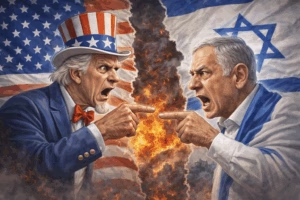

Niger has imposed an indefinite ban on the issuance of visas to United States nationals, effectively barring American citizens from entering the West African country. The decision was reported by the national press agency and attributed to a diplomatic source, signalling a deliberate and calculated response to recent actions taken by Washington against Nigerien citizens.
The move is grounded in the principle of diplomatic reciprocity, a long standing convention in international relations. According to the source cited, the ban reflects Niger’s response to its inclusion on a United States list of countries facing expanded travel restrictions, a step that Niamey views as unjustified and politically motivated.
Shift In Sovereignty And Diplomacy
Niger’s visa ban is also framed as part of a broader assertion of national sovereignty, marking a visible shift in the country’s diplomatic posture. The government appears intent on redefining its international relationships and signalling that decisions affecting its citizens will not go unanswered.
This repositioning aligns with wider regional dynamics in the Sahel, where governments increasingly emphasise autonomy and resistance to perceived external pressure. Niger’s leadership has indicated that diplomatic engagement must be conducted on equal footing, particularly when national dignity and mobility are at stake.
Trump Decree Triggers Escalation
The diplomatic rupture follows a decree signed by United States President Donald Trump on December 16, imposing a full entry ban on several countries. Niger was among five African states affected, alongside Burkina Faso, Mali, South Sudan, and Sierra Leone, with the measures set to take effect on January 1 2026.
According to Washington, the decision was motivated by security concerns and migration enforcement priorities. Niger’s inclusion has been met with strong opposition domestically, where officials argue that the blanket restrictions fail to reflect the complexities of regional security challenges.
Trump cited the activities of terrorist organizations, including attacks and kidnappings in the Sahel state, as well as alleged visa overstays by Nigerien nationals in the US, as justifications for the decision.
Comprehensive Visa Restrictions
The United States suspension applies to both immigrant and nonimmigrant visa categories, significantly limiting legal pathways for Nigerien citizens seeking to travel, work, or study in America. The scope of the restrictions has intensified frustration among Nigerien officials and the broader public.
In response, Niamey’s reciprocal ban mirrors the breadth of Washington’s action, underscoring its intention to match policy with policy rather than pursue symbolic protest. The stance reflects a calculated approach designed to communicate resolve rather than provoke escalation.
Sahel Realignments Deepen Divide
The visa dispute unfolds against the backdrop of shifting geopolitical alignments in the Sahel. The United States has moved to diplomatically isolate Niger and its allies Burkina Faso and Mali following recent coups, including the suspension of development assistance and security cooperation.
Regional governments increasingly frame these measures as interference in domestic affairs, fuelling a narrative of resistance and self determination. Niger’s visa ban is therefore both a bilateral response and part of a collective regional pushback against Western influence.
A Pattern Of African Retaliation
Niger’s action is not an isolated case. Other African states have recently taken similar retaliatory measures in response to United States travel restrictions, reflecting a growing willingness to respond decisively to perceived diplomatic slights.
In June, Chad suspended visa issuance to United States nationals after earlier restrictions were placed on Chadian passport holders. The move set a precedent that appears to be gaining traction across the continent.
Mali Escalates With Financial Barriers
In October, Mali introduced additional countermeasures, requiring United States nationals to post substantial financial bonds when applying for business and tourist visas. The policy was explicitly framed as a response to reciprocal requirements imposed by Washington.
This financial barrier highlighted the increasing sophistication of retaliatory strategies, moving beyond symbolic bans to measures with tangible economic and administrative consequences.
| Country | Measure Against US Nationals | Details |
|---|---|---|
| Chad | Visa Suspension | All visas for US nationals suspended |
| Mali | Visa Bond Requirement | Bond of up to $10,000 for tourist and business visas |
| Niger | Visa Ban | Indefinite ban on issuance of visas to US nationals |
Diplomacy At A Breaking Point
The unfolding standoff between Niger and the United States reflects deeper tensions in global diplomacy, where security narratives, migration control, and sovereignty increasingly collide. For Niger, the visa ban represents a declaration that unilateral decisions affecting its citizens will not be absorbed quietly.
As more African states adopt reciprocal measures, the long term implications for diplomatic engagement, mobility, and international cooperation remain uncertain. What is clear is that Niger’s decision marks a turning point in how smaller states choose to assert agency in an increasingly fragmented global order.