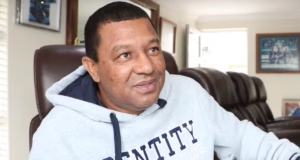
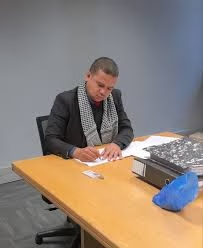
KwaZulu-Natal Premier Thami Ntuli has moved decisively to endorse provincial police commissioner Lieutenant General Nhlanhla Mkhwanazi for a second term, a political intervention that lands at a moment of intense national scrutiny over the leadership and integrity of South Africa’s policing structures. The endorsement follows high level engagements between Ntuli and National Police Commissioner General Fannie Masemola, and comes just months before Mkhwanazi’s current five year term reaches its scheduled end at the close of March.
In a province grappling with entrenched organised crime, political assassinations and some of the highest murder rates in the country, Ntuli’s support signals continuity rather than caution. It is an explicit vote of confidence in a police chief whose leadership style has divided opinion but has also delivered a visible, forceful presence against criminal syndicates operating across KwaZulu-Natal.
A Commissioner Defined By Confrontation
Mkhwanazi’s tenure has been marked by an unapologetically aggressive approach to crime fighting, particularly against organised criminal networks that have long thrived in the province. His public posture, often direct and confrontational, has earned him praise from communities desperate for safety, and criticism from those who argue that his style risks politicising the police service.
Supporters argue that Mkhwanazi has restored a sense of authority and urgency within a province where lawlessness had become normalised. Detractors counter that his prominence and public statements blur the line between operational policing and political contestation, an accusation that has only intensified following his public allegations of systemic corruption.
Explosive Allegations Shake The State
In July last year, Mkhwanazi ignited a national firestorm when he made far reaching claims of political interference and criminal capture within the South African Police Service and elements of the broader justice system. He alleged that investigations, intelligence operations and prosecutions had been deliberately undermined to protect powerful interests.
Those claims placed him at the centre of a debate far larger than his provincial mandate, raising uncomfortable questions about the independence of law enforcement in South Africa. The allegations also positioned Mkhwanazi not only as a police commander, but as a whistleblower challenging entrenched power within the state.
Oversight Bodies Enter The Fray
The fallout from Mkhwanazi’s statements led to the establishment of two parallel oversight processes, the Madlanga Commission of Inquiry and a parliamentary ad hoc committee. Both bodies were tasked with interrogating whether senior law enforcement officials, politicians and private interests had colluded to manipulate the criminal justice system for personal or political gain.
While neither process has concluded its work, early engagements by the parliamentary committee have already exposed troubling weaknesses in governance, command accountability and internal oversight within the security cluster. These preliminary findings have amplified concerns that Mkhwanazi’s claims may reflect deeper structural failures rather than isolated misconduct.
Whistleblowers And The Cost Of Speaking Out
Central to the unfolding inquiry is the question of how whistleblowers within the security services are treated, protected or punished. Mkhwanazi’s position as a serving provincial commissioner has provided him a platform that many others lack, but it has not insulated him from political and institutional pressure.
His critics argue that his public disclosures undermine confidence in the police, while supporters contend that silence in the face of corruption poses a far greater threat to public trust. The tension between these views reflects a broader struggle within South Africa’s democratic institutions over transparency, loyalty and reform.
Constitutional Authority And Political Signal
Ntuli has framed his endorsement within the parameters of Section 207 of the Constitution, which governs the appointment and tenure of provincial police commissioners. By doing so, he has emphasised that the support for Mkhwanazi is rooted in constitutional process rather than personal allegiance.
Nevertheless, the timing of the endorsement carries political weight. With Mkhwanazi expected to return to Parliament to face further questioning by the ad hoc committee, the backing of the provincial executive sends a clear message that KwaZulu-Natal’s leadership is prepared to stand by its police chief as national scrutiny intensifies.
A Province Watches The Next Move
As the Madlanga Commission prepares to commence formal hearings, Mkhwanazi’s credibility, and that of his critics, will be tested under oath. The outcome of these proceedings is likely to shape not only his future, but also public confidence in the state’s ability to confront corruption within its own ranks.
For KwaZulu-Natal, the stakes are particularly high. The province remains a focal point of violent crime and political instability, and the decision on whether Mkhwanazi secures a second term will be read as a measure of how seriously South Africa is prepared to confront the rot alleged within its policing and justice systems.