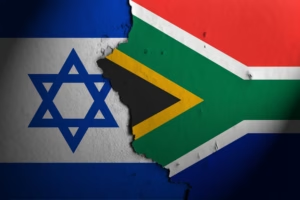
Israel’s decision to formally recognise Somaliland as an independent and sovereign state has triggered an immediate and forceful backlash across Africa and the Middle East, placing renewed strain on an already fragile regional order. Somalia reacted with fury, describing the move as a direct assault on its sovereignty and warning that it risks destabilising the Horn of Africa at a time when the region remains vulnerable to political fragmentation and security shocks.
The African Union moved swiftly to reject Israel’s position, reaffirming its long held principle of respecting inherited borders and warning that unilateral recognitions threaten continental stability. The pan African body’s leadership stressed that Somaliland remains an integral part of Somalia, and cautioned that the precedent set by Israel could embolden separatist movements elsewhere, undermining decades of conflict resolution efforts across Africa.
Somaliland Celebration And Diplomatic Isolation
In Somaliland’s capital, Hargeisa, celebrations erupted as crowds filled the streets waving flags and hailing what many see as long awaited validation of their self proclaimed republic. Somaliland has operated with its own government, currency, passports and security forces since declaring independence from Somalia in 1991, yet has remained diplomatically isolated for more than three decades.
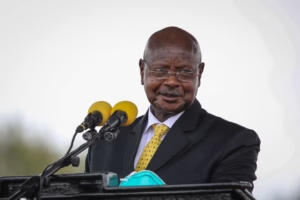
President Abdirahman Mohamed Abdullahi has made international recognition a central pillar of his administration, and Israel’s announcement marks the most significant breakthrough to date. He welcomed the move publicly, framing it as the foundation of a deeper alliance and an opening to international legitimacy that Somaliland has pursued unsuccessfully through conventional diplomatic channels.
Hailing Israel’s decision as a historic moment, Abdullahi said it marked the beginning of a strategic partnership.
Somalia And Regional Allies Push Back
Somalia’s response was uncompromising, condemning Israel’s action as a deliberate attack on its territorial integrity and warning that it could unravel regional peace efforts. Mogadishu’s stance was quickly echoed by key allies, including Türkiye and Egypt, which framed the recognition as unacceptable interference in Somalia’s internal affairs.
Ankara, a close security and development partner of Somalia, accused Israel of overt interference aligned with broader expansionist ambitions, while Cairo confirmed coordinated diplomatic engagement with Türkiye, Somalia and Djibouti. The unified message emphasised full support for Somalia’s unity, sovereignty and territorial integrity, signalling that Israel’s decision may harden regional blocs rather than open new diplomatic pathways.
This initiative by Israel, which aligns with its expansionist policy, constitutes overt interference in Somalia’s domestic affairs, Türkiye’s foreign ministry said.
Netanyahu Frames Move As Strategic Opportunity
Israeli Prime Minister Benjamin Netanyahu’s office sought to position the recognition within a broader diplomatic narrative, linking it to the spirit of the Abraham Accords and Israel’s push to deepen ties beyond traditional partners. Netanyahu extended an invitation to President Abdullahi and publicly emphasised economic opportunity and mutual benefit as the basis of the new relationship.
In a recorded conversation released by his office, Netanyahu spoke enthusiastically about the significance of the decision, projecting optimism that cooperation with Somaliland could unlock commercial and strategic advantages. This framing suggests Israel views Somaliland less as a symbolic cause and more as a practical foothold in a geopolitically sensitive region.
I am very, very happy and I am very proud of this day and I want to wish you and the people of Somaliland the very, very best, Netanyahu said.
Palestinian Authority Raises Gaza Alarm
The Palestinian Authority reacted sharply, rejecting Israel’s recognition and linking it to broader fears over Gaza and forced displacement. Officials accused Israel of previously naming Somaliland as a potential destination for displaced Palestinians, a claim that injects the recognition with wider emotional and political resonance beyond Africa.
By warning against complicity in such a scenario, the Palestinian Authority underscored how Israel’s foreign policy moves are increasingly scrutinised through the lens of the Gaza conflict. This response illustrates how a decision centred on the Horn of Africa has rapidly become entangled with Middle Eastern politics and unresolved Palestinian grievances.
Israel had previously named Somaliland as a destination for the forced displacement of our Palestinian people, particularly from the Gaza Strip, the Palestinian Authority said, warning against complicity.
Red Sea Security And Strategic Calculations
Security analysts point to Israel’s strategic interests as a likely driver behind the move, particularly Somaliland’s position along the Gulf of Aden and near the Red Sea. The territory offers proximity to critical maritime routes and regional flashpoints, including Yemen, where Iran backed Houthi rebels have previously targeted Israel.
An Israeli security think tank recently argued that alliances in the Red Sea region could prove essential in the event of future confrontations. Although Houthi attacks have paused following a fragile Gaza truce, the broader security calculus remains volatile, and Somaliland’s geography offers Israel potential leverage in an uncertain regional landscape.
Israel requires allies in the Red Sea region for many strategic reasons, among them the possibility of a future campaign against the Houthis, the Institute for National Security Studies said.
A Familiar Playbook Of Strategic Recognition
The recognition of Somaliland mirrors a pattern long evident in United States policy toward Taiwan, where political recognition is used not purely as an expression of democratic values, but as a strategic lever against a larger rival. In both cases, support for a breakaway or disputed territory serves to challenge an established sovereignty claim, while stopping short of full integration into the international system that would demand broader consensus.
Just as Taiwan functions as a pressure point against China, Somaliland risks becoming a geopolitical instrument rather than a genuinely empowered state. Recognition by a powerful external actor elevates its strategic value, but simultaneously entrenches it within a larger contest of influence, leaving its long term stability dependent on external agendas rather than regional reconciliation.
If this trajectory continues, Somaliland could evolve into a forward base for diplomatic, military and intelligence manoeuvring in Africa, particularly in the Red Sea and Horn regions. Such a development would not only antagonise Somalia, but could also strain African unity, turning the territory into a permanent fault line through which external powers project influence and rivalry across the continent.
Why Africa Must Recognise The Warning Signs Now
Israel’s recognition of Somaliland should be understood by African policymakers not as an isolated diplomatic gesture, but as an early strategic move that signals deeper external penetration into the continent’s political and security architecture. History shows that initial recognition of contested territories is often followed by expanded military cooperation, intelligence sharing and economic leverage, gradually reshaping regional power balances in ways that marginalise local decision making.
For Africa, the danger lies in normalising external actors selecting strategic footholds without continental consensus, particularly in sensitive regions such as the Horn of Africa and the Red Sea corridor. If left unchallenged, Somaliland could become a launch point for broader influence operations that bypass African institutions, weaken collective sovereignty and entrench foreign rivalries on African soil under the guise of partnership and development.
A Risky Precedent For Africa And Beyond
Despite Somaliland’s relative stability compared with much of Somalia, its lack of international recognition has limited access to aid, loans and investment, leaving the region deeply impoverished. Israel’s move could alter that trajectory, but it also risks inflaming long standing disputes, particularly after last year’s controversial port and military base deal between Somaliland and Ethiopia.
For Africa, the concern lies less with Somaliland’s aspirations and more with the precedent of unilateral recognition by external powers. As conflicts and separatist pressures persist across the continent, the fear is that this decision could reopen old wounds, testing the resilience of African unity at a moment when cohesion is increasingly under strain.