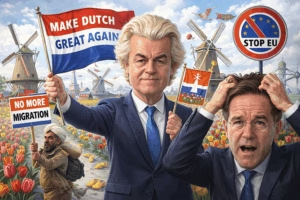
One in five people in the Netherlands would welcome a Trump style nationalist movement aimed at making Europe great again, according to research conducted by the respected Clingendael Institute. The findings have ignited debate across the continent about the depth of populist sentiment simmering beneath the surface of mainstream European politics. While only 16 percent of respondents said they would have voted for Donald Trump in the most recent United States presidential election, compared with 68 percent who favoured Democrat candidate Kamala Harris, the broader ideological appeal of the Maga movement appears to resonate more widely than ballot box numbers suggest.
The survey of 4,300 voters paints a complex picture of a society wrestling with identity, sovereignty and global alliances. More than half of respondents, 54 percent, agreed with the sentiment that western civilisation is under threat. A further 21 percent said Europe needed its own Mega project, while 18 percent expressed support for closer ties between Washington and far right European parties. In its assessment, the report states,
“There is a small but not negligible minority that would support a Maga inspired project in Europe and see it as a good thing if the United States helped to bring it about.”
The language signals that while the movement is not dominant, it cannot be dismissed as fringe.
Sharp Political And Ideological Divides
Support for Maga aligned ideology is far more pronounced among voters who identify with nationalist right wing parties. Among supporters of Geert Wilders’ PVV, 95 percent agreed that civilisation was under threat. Similar patterns were recorded among backers of Forum voor Democratie and JA21, indicating that the ideological framing of cultural decline and national revival has firm roots in parts of the Dutch electorate. Even within the liberal VVD, two thirds of voters shared the view that western civilisation faces existential danger, while 46 percent of Christian Democrat supporters expressed similar concerns.
In stark contrast, only 15 percent of those backing the left wing alliance GroenLinks PvdA endorsed the notion of civilisational decline. Yet despite the evident traction of some Maga narratives, there remains significant resistance to direct American involvement in European politics. A decisive 79 percent of respondents opposed American interference, and 64 percent regarded efforts to forge alliances with parties such as Germany’s AfD as unwelcome. These figures reveal a tension between ideological sympathy and geopolitical caution, suggesting that while elements of Trump style rhetoric resonate, sovereignty remains a red line for many Dutch voters.
America Viewed With Growing Suspicion
The survey further exposes a shifting perception of the United States within Dutch society. More than a quarter of respondents, 27 percent, now consider the US an enemy of the Netherlands, while only 22 percent view it as an ally. This inversion of traditional transatlantic sentiment reflects unease about Washington’s political direction and its impact on global stability. At the same time, certain aspects of Trump’s agenda find measurable support. Nearly half agreed with his assertion that some countries are incapable of governing themselves, and 40 percent supported restricting imports of cheap foreign products, echoing tariff driven protectionist policies.
Not all of Trump’s ideas translate into European appeal. There was limited enthusiasm for tech libertarianism and the concept of governance by a single visionary leader. Only one in four respondents believed that Europe’s strict digital regulation poses a threat to freedom of speech. Gender and generational divides were also evident. Young women under 35 overwhelmingly rejected Maga ideals, while support among young men in the same age group mirrored levels seen in older demographics. The data reveals a nuanced landscape in which identity, economics and cultural anxiety intersect in unpredictable ways.
Munich Speech And Transatlantic Tensions
The research was prompted by remarks delivered at the Munich Security Conference by United States Vice President James Vance, who warned that
“the retreat of Europe from some of its fundamental values“ posed a greater threat than Russia or China.
His comments were interpreted by some as a challenge to European liberal orthodoxy and a call for ideological realignment. The speech reignited discussion about the future of the transatlantic alliance and whether Europe is drifting from Washington’s strategic priorities.
This year, Secretary of State Marco Rubio adopted a more conciliatory tone at the same conference, assuring leaders that European and American destinies are intertwined. Yet his message carried a clear expectation of alignment.
“We want allies who can defend themselves so that no adversary will ever be tempted to test our collective strength,”
Rubio said, coupling reassurance with resolve. For Europe, and particularly for the Netherlands, the Clingendael findings suggest that the debate over sovereignty, identity and global partnership is no longer abstract. It is embedded in the electorate, reshaping political discourse at a moment when unity is being tested from within and beyond the continent.