
WikiLeaks co-founder Julian Assange has lodged a criminal complaint with Sweden’s Economic Crime Authority and War Crimes Unit, accusing the Nobel Foundation of breaching the peace clause in Alfred Nobel’s will. The complaint, filed on Wednesday, alleges that the 2025 Peace Prize was unlawfully awarded to Venezuelan opposition leader Maria Corina Machado, who has openly urged the United States to launch military strikes against her own country. Assange argues that Nobel’s testament explicitly bars prize money from bankrolling any party that promotes armed conflict, and that the Foundation’s disbursement to Machado therefore violates Swedish fiduciary and criminal law.
The filing contends that the Nobel Foundation has transformed its iconic accolade into what Assange calls an “instrument of war,” providing both moral cover and hard cash to a political figure campaigning for foreign bombardment. By handing Machado the prize purse, the Foundation is, in effect, subsidizing a casus belli, the complaint states, risking the credibility of an award once synonymous with disarmament and diplomacy. Swedish prosecutors have confirmed receipt of the documentation, yet declined to comment on whether a formal inquiry will follow.
Instrument Of War Allegation Centers On Machado Statements
The core of Assange’s grievance is a dossier of public remarks in which Machado endorsed Washington’s escalating military posture toward Caracas. The complaint quotes her praise for US naval interdictions off Venezuela’s coast, operations that have killed 95 people the US labels “narco-terrorists” but which United Nations monitors have condemned as “extrajudicial killings.” Machado has repeatedly characterized American firepower as a legitimate tool for regime change, arguing that sovereignty must bow to what she terms “the moral obligation to liberate Venezuela.”
According to the submission, such statements convert Nobel funds into seed money for aggression, breaching the charter obligation to promote “fraternity between nations.” Assange’s legal team highlights a tweet from Machado posted hours after the award ceremony in Oslo, in which she thanked the Nobel committee and immediately called on the Pentagon to “finish the job” against the Maduro government. The complaint warns that every krona spent on her political network risks underwriting further bloodshed, thereby exposing the Foundation to complicity claims under Swedish penal code chapter 22, which governs war crimes and crimes against humanity.
Nobel Foundation Silent As Trump Floats Largest Armada
The Nobel Foundation has declined to address the substance of Assange’s filing, issuing only a brief statement that “the 2025 Peace Prize has been conferred in accordance with established procedures.” Yet silence has done little to quell controversy, especially after US President Donald Trump boasted on Tuesday that Venezuela is now encircled by
“the largest armada ever assembled in the history of South America.”
Speaking at a White House briefing, Trump vowed to tighten the maritime choke-hold until Caracas “returns all the oil, land and other assets that they previously stole from us,” rhetoric that critics say dovetails with Machado’s pleas for intervention.
Assange’s complaint underscores that timing is hardly coincidental: the peace prize bestows international legitimacy exactly as Washington prepares what Trump hinted could be “land strikes soon.” By anointing Machado, the Nobel committee has handed the US a ready-made moral narrative, the filing alleges, allowing American officials to couch territorial designs in humanitarian language. The document places special emphasis on Venezuela’s estimated $1.7 trillion in untapped hydrocarbons, suggesting that prize-induced prestige paves the way for resource expropriation masked as liberation.
Assange Warns Nobel Peace Prize Becomes Casus Belli
The WikiLeaks publisher argues that Alfred Nobel’s original mandate is being inverted: rather than incentivizing disarmament, the award now functions as a diplomatic weapon, greasing the skids for confrontation. The complaint cites precedents ranging from Barack Obama’s 2009 prize to Ethiopian Prime Minister Abiy Ahmed, claiming both laureates escalated military campaigns soon after their ceremonies. Yet, Assange contends, the Machado case marks the first time a recipient has actively courted an invasion of her homeland while still basking in Nobel largesse.
Legal scholars note that Swedish courts rarely intervene in private-foundation affairs, but warn that a criminal designation could compel the Nobel Foundation to claw back funds or face fines. Assange’s submission requests that authorities freeze the remainder of Machado’s 10-million-krona purse pending investigation, and asks prosecutors to consider indicting board members for aiding and abetting an unlawful conflict. Whether or not Stockholm acts, the complaint has already rattled Nobel alumni, with several past laureates privately expressing unease over the militarization of peace.
Global Fallout Grows From Nobel Instrument Of War Row
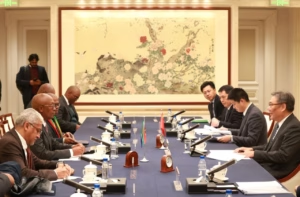
International reaction has split along geopolitical lines. Russian Foreign Minister Sergey Lavrov warned Wednesday that US naval actions off Venezuela
“undermine hopes that an agreement can be reached”
with Washington, echoing Assange’s charge that the prize bestows unearned legitimacy. China’s Foreign Ministry called for
“strict respect for the purposes of the Nobel Peace Prize,”
while a coalition of Latin American leaders petitioned the Stockholm district court to admit them as civil parties, arguing that an intervention triggered by Nobel prestige would destabilize the entire region.
Conversely, US lawmakers have rallied behind Machado, branding Assange’s complaint “lawfare designed to silence freedom fighters.” Senate hawks are now pushing a bipartisan resolution congratulating the Nobel committee for “standing with the Venezuelan people,” language that implicitly endorses military options. The escalating rhetoric has jolted global energy markets, with Brent crude rising 2.3 percent on fears of a blockaded Orinoco belt. As diplomats scramble for leverage, the once-unthinkable notion that a peace prize could serve as an instrument of war has moved from polemic to courtroom reality.