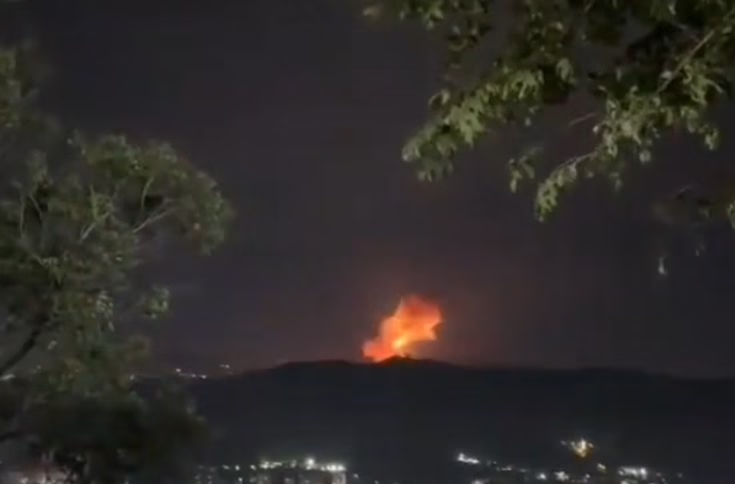
Residents of Caracas were jolted awake in the early hours of Saturday as multiple explosions echoed across Venezuela’s capital, sending shockwaves through neighbourhoods already strained by years of political tension and economic hardship. Reports from international media and footage shared from the scene described at least seven distinct blasts around 2am local time, accompanied by the roar of aircraft flying unusually low over the city. For many residents, the night unfolded in confusion, marked by power outages in parts of the capital and uncertainty over what was unfolding above them.
Trump 🇺🇸 orders air strikes on Caracas, the capital of Venezuela 🇻🇪
Acts of war. To steal oil & minerals
US 🇺🇸 foreign policy has normalised land & mineral theft
International law has been torn up
The world is run by gangsters masquerading as ‘leaders’. pic.twitter.com/USU3JuWKkN
— Howard Beckett (@BeckettUnite) January 3, 2026
The explosions come at a moment of deepening confrontation between Venezuela and the United States, with Caracas long accusing Washington of pursuing regime change through economic pressure and covert action. While the full extent of the damage was not immediately clear, the timing and scale of the blasts have raised fears of a significant escalation in a standoff that has simmered for years, now appearing to edge closer to open conflict.
Caracas Night Filled With Aircraft And Uncertainty
Journalists on the ground reported intense aerial activity coinciding with the explosions. RT correspondent Murad Gadziev said jets and what he described as possible drones were audible overhead, alongside helicopters moving across the capital. He suggested that the type and frequency of aircraft indicated organised military activity rather than routine patrols or domestic security operations, a claim that quickly fuelled speculation across social media and international newsrooms.
Adding to the uncertainty, CBS journalist Jennifer Jacobs reported, citing unnamed US officials, that
“President Trump ordered strikes on sites inside Venezuela, including military facilities”
. While no immediate confirmation was issued by Washington, the report intensified concerns that the explosions were linked to direct US military action, a step that would mark a dramatic shift in relations between the two countries.
Caracas Authorities Accuse United States Of Aggression
Venezuelan officials responded forcefully, accusing the United States of orchestrating what they described as a serious act of military aggression. In an official statement, authorities said they
“reject, repudiate and denounce before the international community the grave military aggression perpetrated by the current Government of the United States of America”
, alleging that both civilian and military locations had been targeted in Caracas and surrounding states.
The government further claimed that the attacks extended beyond the capital, naming Miranda, Aragua and La Guaira among the affected regions. According to Venezuelan sources cited by regional broadcasters, the home of the defence minister and a port facility in the capital were among the sites struck, while witnesses told Reuters that parts of Caracas were left without electricity in the aftermath of the blasts.
Maduro And Wife Kidnapped by US Government
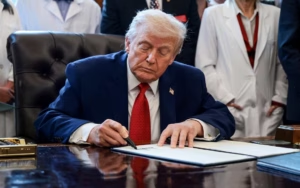
In a statement posted on Truth Social on Saturday, US President Donald Trump said the United States had
“successfully carried out a large scale strike against Venezuela,”
marking the first direct public confirmation from Washington following reports of overnight explosions in Caracas.
Trump went on to claim that Venezuelan President Nicolas Maduro and his wife had been captured during the operation and removed from the country, stating that the action was conducted in coordination with US law enforcement agencies. He said further details would be disclosed during a news conference scheduled for 11am at his Mar a Lago residence in Florida, signalling that the administration intended to formally address the developments later in the day.
Caracas At Centre Of Regional Alarm
The shockwaves from Caracas were felt beyond Venezuela’s borders. Colombian President Gustavo Petro reacted publicly, warning that
“right now they are bombing Caracas. Alert to the whole world, they have attacked Venezuela”
. While Petro stopped short of assigning direct blame, he called for an emergency meeting of the United Nations Security Council, signalling fears that the situation could spiral into a broader regional crisis.
The call for international intervention reflects longstanding concerns in Latin America about the consequences of military action against Venezuela. Neighbouring countries, already grappling with migration flows and economic instability linked to Venezuela’s prolonged crisis, face the prospect of further upheaval should hostilities intensify.
Caracas Explosions Deepen Political Standoff
The reported strikes come amid heightened tensions between Washington and Caracas, with the United States accusing Venezuela’s government of facilitating large scale drug trafficking. President Donald Trump has authorised expanded US military operations targeting suspected smuggling routes in the Caribbean and eastern Pacific, framing these moves as part of a broader campaign against organised crime.
Venezuelan President Nicolas Maduro has repeatedly rejected these allegations, accusing the United States of using anti drug operations as a pretext for political intervention. He has warned that any direct military action would be met with resistance, a stance that underscores the high stakes of the current moment as Caracas and Washington trade accusations with little sign of de escalation.
Illegal By Any Measure The Kidnapping Of Foreign Presidents Under International Law
The abduction or forcible removal of a sitting foreign president is widely regarded as illegal under international law and is considered one of the most serious violations of state sovereignty. Such an act goes beyond conventional military engagement and enters the realm of unlawful intervention, prohibited by the United Nations Charter and long established principles governing relations between states. International law draws a clear distinction between armed conflict, which itself is tightly regulated, and the personal seizure of a head of state, which is not recognised as a lawful act under any accepted legal framework.
Under the UN Charter, particularly Article 2(4), states are prohibited from using force against the territorial integrity or political independence of another state. Kidnapping a foreign president directly undermines both principles. It removes a country’s elected or installed leader through coercion rather than legal or diplomatic processes and effectively amounts to an attempt at regime change by force. Even during armed conflict, heads of state are not considered lawful targets for capture outside clearly defined combat operations governed by international humanitarian law.
Customary international law also affords heads of state personal inviolability and immunity while in office. This protection is intended to ensure the functioning of international diplomacy and prevent chaos in global relations. Forcible detention or transfer of a sitting president without the consent of the state concerned violates these immunities, regardless of political disputes, criminal allegations, or accusations made by another government. Legal accountability for leaders, where it applies, is meant to occur through recognised international mechanisms such as international tribunals, not unilateral action by a foreign power.
From a legal standpoint, even claims of criminal conduct do not justify abduction. International law requires extradition processes, formal indictments, and judicial cooperation between states. Unilateral seizure bypasses due process entirely and sets a dangerous precedent where powerful states could claim the right to detain foreign leaders based on their own legal or political interpretations. This undermines the rule based international order and exposes smaller or weaker states to arbitrary intervention.
The political consequences are equally severe. Kidnapping a foreign president risks escalating conflicts, destabilising entire regions, and eroding already fragile diplomatic norms. It signals that negotiation, mediation, and international institutions can be discarded in favour of force. For many countries, particularly in the Global South, such actions revive historical fears of imperial overreach and external domination under the guise of security or law enforcement.
In practice, the international community has consistently treated the abduction of foreign leaders as unlawful, even when carried out covertly. Past incidents involving the seizure of political figures abroad have drawn condemnation, legal challenges, and long term diplomatic fallout. The principle at stake is not the character or conduct of any individual leader, but the protection of international order itself.
Ultimately, the prohibition against kidnapping foreign presidents exists to prevent a descent into lawlessness in global affairs. Once the personal security and legal immunity of heads of state are discarded, no government can be assured of sovereignty or stability. For this reason, international law remains unequivocal, the removal of a sitting president by force from foreign soil is illegal, regardless of the political justification offered.
| Reported Incident Details | Information |
|---|---|
| Time Of Explosions | Around 2am Local Time |
| Number Of Explosions Heard | At Least Seven |
| Areas Reported Affected | Caracas, Miranda, Aragua, La Guaira |
As dawn broke over Caracas, the city remained tense, with residents seeking clarity amid conflicting reports and official statements. What is clear is that the explosions have pushed an already fragile geopolitical situation into a more dangerous phase, one that now commands the attention of governments and international institutions alike.
For ordinary Venezuelans, the fear is immediate and personal. Years of economic strain and political uncertainty have left little room for another crisis, particularly one involving foreign military force. Whether diplomacy can still pull the situation back from the brink remains an open and pressing question.