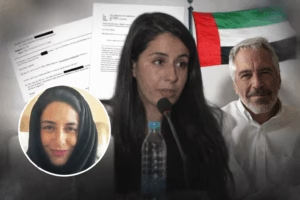

Newly released records from the United States Department of Justice have cast an intense international spotlight on Emirati diplomat Hind Al Owais after her name appeared in 469 emails linked to convicted sex offender Jeffrey Epstein. The correspondence, dated between 2010 and 2012, formed part of a broader document disclosure connected to the late financier’s criminal case and subsequent investigations. Although Al Owais has not been charged with any offence, the sheer volume of emails has ignited debate about her past professional associations and the reputational risks they pose to the institutions she represents.
The disclosures confirm that all exchanges took place after Epstein’s 2008 conviction for soliciting prostitution from a minor, a fact that has intensified scrutiny. There is no evidence contained within the released files to suggest that Al Owais participated in criminal conduct, yet the revelations have prompted renewed examination of the boundaries between professional networking and ethical judgment in diplomatic and financial circles.
Profile Of A High Ranking Diplomat
Hind Al Owais has long been regarded as a prominent figure within the United Arab Emirates diplomatic establishment. She has served as Director of the UAE Permanent Committee for Human Rights, a body created in 2019 to promote and coordinate the country’s human rights strategy. Over the years, she has represented the UAE at the United Nations and has been widely recognised for advocacy focused on gender equality, women’s empowerment, and global development policy.
In 2015, she became one of the first Emirati women appointed to a senior international role at the United Nations headquarters in New York, according to public interviews given at the time. Her speeches frequently addressed women’s participation in governance and the integration of gender perspectives into international policymaking frameworks. These credentials have formed a significant part of her public profile, now juxtaposed against the controversy surrounding her name’s appearance in the Epstein files.
Email Exchanges Raise Questions
The Department of Justice files reveal a series of personal and professional messages between Al Owais and Epstein. In one email dated January 2012, Al Owais wrote,
“Are you in town?? My sister is here and I have told her so much about you…. I want her to meet you…. Let me know when!!!!! Kisses Hind.”
Epstein replied with a proposed day, prompting her response,
“Hi already in discussions with [redacted] on time- I am so excited to see you and introduce you to my sister- she is even prettier than me!!!!!”
Other correspondence indicates discussions about potential career opportunities in New York. In a May 2011 memo, Al Owais informed Epstein that she would likely be relocating to the city and asked if he “had any ideas on getting a job”. Months later she inquired,
“Could you teach me how to make money??”
In October 2011, Epstein responded,
“There is a person i think that might be helpful to your future job, here at my house today at 3, if you have a chance.”
Nature Of The Relationship Examined
The emails appear to confirm that Al Owais and Epstein met on several occasions and were at minimum close acquaintances within overlapping professional networks. In December 2012 she wrote,
“You have forgotten me, but I haven’t:)!! Hope you are well, would love to see you soon.”
The tone of the messages has drawn intense analysis, particularly given the timing of the exchanges after Epstein’s criminal conviction.
Several emails refer to “His Highness” or “HH”, an honorific used for senior members of ruling families in the Emirates. In one message Al Owais wrote,
“As for the continuing cooperation in the field of science, I really do hope we find areas of mutual interest. I know His Highness enjoyed meeting you as well.”
The identity of the individual referenced remains unclear from the documents, and no official clarification has been provided.
Online Defences And Public Reaction
In recent days, Emirati social media figures have publicly defended Al Owais, arguing that professional correspondence does not equate to criminal involvement. Ahmed Sharif al Ameri, a UAE social media personality, stated,
“At the time referenced, she was 27 years old, an adult, a professional, operating in New York in an investment environment where introductions, correspondence, and meetings are routine.”
He continued,
“Professional contact is not criminal participation. A meeting request is not endorsement. A business exchange is not knowledge of someone’s private life.”
Addressing the now widely circulated remark about her sister being “prettier than me”, Ameri argued that it had been misinterpreted, adding,
“Anyone who has operated an international business… should understand that light remarks are often used to break the ice.”
Institutional Silence And Unanswered Queries
Efforts to obtain direct comment from Al Owais have so far proved unsuccessful. Media organisations have reported contacting the UAE Permanent Committee for Human Rights, the UAE foreign ministry, the Anwar Gargash Diplomatic Academy, and the World Governments Summit without receiving responses by the time of publication. The absence of official clarification has fuelled speculation and intensified media coverage across the Middle East and beyond.
The controversy has unfolded alongside broader scrutiny of Emirati figures named in the Epstein files. Sultan Ahmed bin Sulayem, a prominent businessman, was recently replaced as head of DP World and Dubai’s Ports, Customs and Free Zone Corporation following days of attention over his documented friendship with Epstein. Released emails showed a decades long professional and personal relationship that included discussions about business, politics, religion, and travel.
Digital Footprints Quietly Removed
Parallel to the unfolding revelations, numerous online references to Al Owais appear to have been removed. Mentions of her role as Director of the Permanent Committee for Human Rights have reportedly disappeared from the organisation’s Instagram, X, LinkedIn, and official website. Posts as recent as two weeks prior to the document release were no longer visible, including references to her participation in the Sixth Global Tolerance and Human Fraternity Conference held in Dubai on 2 February 2025.
Archived search previews indicate that pages describing her moderation of events and participation in human rights dialogues were accessible until recently. A page on the website of the Anwar Gargash Diplomatic Academy listing her as a moderator was replaced with a “404 Page not found” message. Similarly, a profile identifying her as a past speaker at the World Governments Summit, previously listing her experience as Senior Vice President of International Participants at Expo 2020, no longer exists and now redirects to the homepage.
Broader Implications For Governance And Transparency
The removal of online material has prompted questions about transparency and institutional accountability. Analysts note that reputational management during periods of controversy is not uncommon, particularly in highly centralised governance environments. However, the absence of public explanation can generate further scepticism and undermine confidence in official communications.
For Al Owais, the episode represents a complex intersection between personal association and public office. There is no evidence that she engaged in illegal conduct, yet the optics of extensive post conviction communication with a figure such as Epstein carry undeniable reputational consequences. As the documents continue to be analysed, the diplomatic and political ramifications are likely to persist, placing renewed focus on ethical vetting, public disclosure, and the standards expected of officials operating on the global stage.