South Africa has taken one of its strongest diplomatic steps in recent years, formally declaring the Israeli Chargé d’Affaires persona non grata and ordering his departure from the country within 72 hours. The decision, announced in an official media statement issued on 30 January 2026, marks a significant escalation in already strained relations between Pretoria and Tel Aviv.
The Department of International Relations and Cooperation confirmed that Mr Ariel Seidman, the Chargé d’Affaires of the Israeli Embassy, had been informed of the decision. Such declarations are uncommon in international diplomacy and are typically reserved for cases where trust between states has severely deteriorated, signalling a breakdown in acceptable diplomatic conduct.
Claims Of Repeated Diplomatic Violations
According to the department, the decision followed what it described as a series of unacceptable violations of diplomatic norms and practice. These actions, the statement said, posed a direct challenge to South Africa’s sovereignty and the integrity of its state institutions, prompting decisive intervention by the government.
This decisive measure follows a series of unacceptable violations of diplomatic norms and practice which pose a direct challenge to South Africa’s sovereignty.
The department detailed concerns about repeated conduct that it believes crossed established diplomatic boundaries and eroded the foundations required for respectful bilateral engagement.
Social Media Conduct And Protocol Breaches
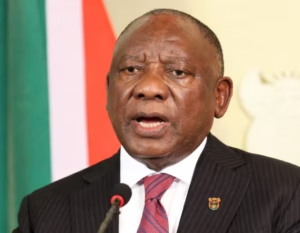
Central to the government’s concerns was the alleged use of official Israeli social media platforms to launch what it described as insulting attacks against President Cyril Ramaphosa. In diplomatic circles, public criticism of a host country’s head of state by an accredited envoy or official channel is viewed as highly provocative and outside accepted practice.
The department further cited what it called a deliberate failure to inform DIRCO of purported visits by senior Israeli officials to South Africa. Such omissions, it argued, breached established diplomatic protocols that are essential for transparency, coordination, and mutual respect between states.
Violation Of International Diplomatic Law
The media statement framed the conduct as more than a political disagreement, characterising it as a gross abuse of diplomatic privilege. The government said these actions amounted to a fundamental breach of the Vienna Convention, the cornerstone treaty governing diplomatic relations worldwide.
Such actions represent a gross abuse of diplomatic privilege and a fundamental breach of the Vienna Convention.
By invoking the Vienna Convention explicitly, South Africa signalled that its response was grounded in international law rather than ideological positioning alone.
Trust And Bilateral Relations Eroded
The department stated that the alleged actions had systematically undermined the trust and protocols essential for maintaining functional bilateral relations. Diplomacy, it stressed, relies on adherence to formal processes and mutual restraint, even during periods of political disagreement.
South Africa’s statement emphasised that the sovereignty of the Republic and the dignity of its offices are inviolable. This language reflects a firm assertion of state authority and a warning that conduct perceived as disrespectful or hostile will not be tolerated, regardless of the country involved.
Order To Depart Within Seventy Two Hours
As part of the declaration, Mr Seidman was instructed to leave South Africa within 72 hours. This time frame aligns with international practice in persona non grata cases and signals the seriousness with which Pretoria views the matter.
The expulsion effectively removes Israel’s top diplomatic representative currently stationed in the country, creating a diplomatic vacuum that will require careful management should relations be stabilised in the future.
Message To The Israeli Government
Beyond the immediate action, the statement carried a broader diplomatic message. South Africa urged the Israeli government to ensure that its future diplomatic conduct reflects respect for the Republic and for established principles of international engagement.
We urge the Israeli government to ensure its future diplomatic conduct demonstrates respect for the Republic and the established principles of international engagement.
This appeal suggests that while relations are under severe strain, Pretoria has not closed the door entirely on engagement, provided norms are respected.
Broader Implications For Foreign Policy
The move is likely to resonate beyond the bilateral relationship, reinforcing South Africa’s long stated position that diplomatic engagement must be rooted in respect for sovereignty and international law. It also reflects a willingness by the government to translate rhetorical positions into concrete action.
As global attention remains fixed on South Africa’s foreign policy stance, the expulsion of a senior Israeli diplomat sends a clear signal that Pretoria is prepared to defend its diplomatic boundaries firmly, even when doing so risks deepening international tensions.