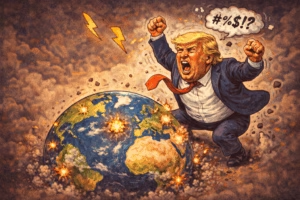
South Africa’s struggle with violent crime has again been thrust into the international spotlight, not through new data or shocking revelations, but through the revival of a long disputed political claim. Democratic Alliance leader and Agriculture Minister John Steenhuisen has directly rejected assertions that South Africa is facing a so called white genocide, stating that the country’s crime crisis is brutal, widespread, and tragically indiscriminate. His remarks came amid renewed comments by United States President Donald Trump, who has repeated allegations of racial persecution despite years of official data and expert analysis contradicting such claims.
Steenhuisen did not downplay the seriousness of crime, particularly in rural areas where farm murders have long been a source of fear and anger. Instead, he framed the issue as one of shared national trauma rather than racial targeting. The violence, he stressed, cuts across communities, geography, and history, undermining attempts to recast it as a racially exclusive phenomenon. In doing so, Steenhuisen sought to reclaim the narrative from those who, in his view, simplify South Africa’s complex social challenges for ideological gain.
Statistics And Shared Suffering
Responding to questions from the Press Gallery Association, Steenhuisen leaned on what he described as “cold, hard statistics” to rebut claims of racial extermination. He acknowledged that white South Africans are among the victims of violent crime, but insisted they are far from the only ones. Murders, he said, continue to devastate black, coloured, Indian South Africans and people of South Asian descent, reflecting a crisis rooted in systemic violence rather than racial persecution.
“We have white people murdered, yes, but we also have coloured and black South Africans as well as Indian South Africans and South of Asian descent that are being murdered as well,”
By emphasising this reality, Steenhuisen positioned crime as a national emergency requiring sober analysis rather than inflammatory rhetoric. His comments implicitly challenged international audiences to move beyond viral narratives and engage with South Africa as it is, a country grappling with inequality, unemployment, and historical trauma that continue to feed cycles of violence.
Trump Allegations And A Distorted Image
The Democratic Alliance leader was blunt in his assessment of the renewed claims from Washington. According to Steenhuisen, the repeated assertion that white genocide exists in South Africa reflects not ignorance but deliberate distortion. He suggested that President Trump has been fed a false version of the country’s reality and continues to promote it despite overwhelming evidence to the contrary.
“Despite all the evidence to the contrary, the hard statistics and many efforts to display that this is not the case in South Africa, that is his perception of the country.”
Steenhuisen went further, arguing that facts alone would not shift this stance because the narrative serves a political purpose. He likened the situation to a well known proverb, pointing to the futility of persuasion when ideology has already taken root.
Diplomacy And National Interest
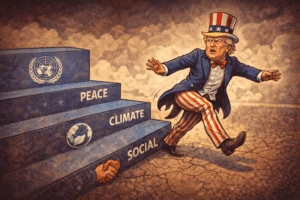
Beyond the immediate controversy, Steenhuisen framed the issue as a matter of strategic diplomacy. He argued that South Africa and the United States have historically benefited from cooperation, and that the erosion of trust did not begin with Trump’s presidency alone. For Steenhuisen, the real failure lies in the absence of a clear, consistently applied definition of South Africa’s national interest in foreign affairs.
“That is why it is so fundamentally important that we understand what our national interest is, unpack that national interest in granular detail, and then use that as the decision-making matrix about how we position ourselves in international affairs.”
He maintained that a principled, interest driven approach would lead to wiser decisions on the global stage and reduce vulnerability to mischaracterisation by foreign leaders.
Missed Partnership On A Global Stage
Steenhuisen described it as deeply unfortunate that the United States risked sidelining its relationship with what he called the most industrialised country on the African continent. He highlighted South Africa’s constitutional democracy and Bill of Rights, noting their close alignment with values the United States claims to champion internationally.
“South Africa is a wonderful country. There are incredible things happening here, but yes, there are bad things happening here, just as in the United States.”
By drawing this comparison, Steenhuisen sought to humanise South Africa’s struggles, reminding critics that no nation is immune to violence or social breakdown. In his view, rejecting partnership based on false perceptions harms both countries and diminishes opportunities for shared progress.
Democracy As A Defining Identity
At the heart of Steenhuisen’s argument was a defence of South Africa’s democratic identity. He portrayed the country’s constitutional framework and democratic journey as a point of pride, not only domestically but across the continent. For him, these achievements stand in stark contrast to narratives that reduce South Africa to a caricature of racial collapse.
“Our commitment to democracy, our journey to democracy, our values in our constitution and Bill of Rights all stand out there as a beacon on the continent.”
Steenhuisen warned that abandoning relationships based on misinformation would ultimately leave those who turn away poorer in influence and understanding. His remarks reflected a broader appeal for nuance, restraint, and honesty in how South Africa is discussed, both at home and abroad.