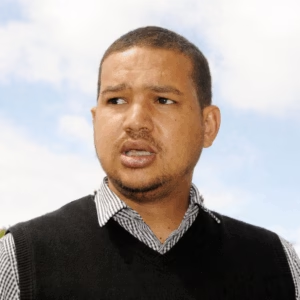
The sentencing of a former Steinhoff director has marked another sobering chapter in one of South Africa’s most damaging corporate scandals, reinforcing the slow but deliberate march toward accountability. Iwan Peter Schelbert, a former director and board member of Steinhoff at Work, has been sentenced to five years’ imprisonment after admitting to his role in a fraudulent scheme that inflated company finances by more than R376 million.
Handing down sentence in the Pretoria Specialised Commercial Crimes Court, the magistrate ordered direct imprisonment under section 276(1)(i) of the Criminal Procedure Act. The sentence follows Schelbert’s decision to enter into a plea and sentence agreement with the State, an acknowledgement of wrongdoing that spared the court a prolonged trial but underscored the gravity of the offence.
Inside The Mechanics Of A Calculated Fraud Scheme
According to the National Prosecuting Authority, Schelbert held his position at Steinhoff at Work from June 2004 until March 2018, a period during which the company formed part of a global retail empire that would later unravel spectacularly. In November 2016, acting on instructions from then chief financial officer Andries Benjamin La Grange, Schelbert generated a fraudulent invoice directed to TG Sources SARL, a company registered in Switzerland.
The invoice was not an isolated act. Investigators established that additional supporting documents were created by Stephanus Johannes Grobler and other individuals to falsely present the transaction as legitimate. These documents were used to justify payments, allowing funds to move under the guise of lawful business dealings while materially distorting Steinhoff’s financial position.
How Inflated Figures Misled Markets And Stakeholders
The fraudulent documentation resulted in the artificial inflation of Steinhoff’s financial statements by more than R376 million, a figure that represents more than just a balance sheet anomaly. Such manipulation misled investors, creditors, employees, and regulators, contributing to the broader collapse of confidence that engulfed the company once the full extent of irregularities emerged.
Corporate governance experts have long argued that accounting fraud of this magnitude undermines the integrity of financial markets and erodes public trust in listed companies. In the Steinhoff case, inflated figures created an illusion of stability and performance, masking underlying weaknesses while exposing stakeholders to enormous financial risk.
The Scale Of Losses In Context
While the current conviction focuses on a specific transaction, the financial impact is best understood in numerical terms. The value attributed to this single scheme illustrates how incremental acts of fraud can accumulate into staggering losses, particularly within complex multinational structures.
Law Enforcement Signals Determination And Capacity
The National Prosecuting Authority and the Directorate for Priority Crime Investigation, known as the Hawks, welcomed the conviction and sentence, describing it as the third successful outcome in the protracted Steinhoff prosecutions. Both institutions emphasised the level of technical expertise and cooperation required to unravel transactions that spanned jurisdictions and corporate entities.
The investigation demanded forensic accounting, international cooperation, and sustained prosecutorial focus, a combination often cited as lacking in complex commercial crime cases. This conviction therefore carries symbolic weight, signalling that large scale corporate fraud is not beyond the reach of South Africa’s criminal justice system.
Accountability Extends Beyond A Single Accused
Schelbert’s sentence does not close the book on the matter. The case against remaining accused Hein Adendaal and Stephanus Johannes Grobler continues, with proceedings postponed until February 6 2026. Their anticipated court appearance maintains public attention on a scandal that has yet to yield full judicial closure.
For many observers, the Steinhoff prosecutions represent a test of whether senior corporate figures can be held personally responsible for financial crimes committed behind boardroom doors. Each conviction reinforces the principle that professional stature and corporate rank do not place individuals above the law, particularly when deliberate deception causes widespread economic harm.