
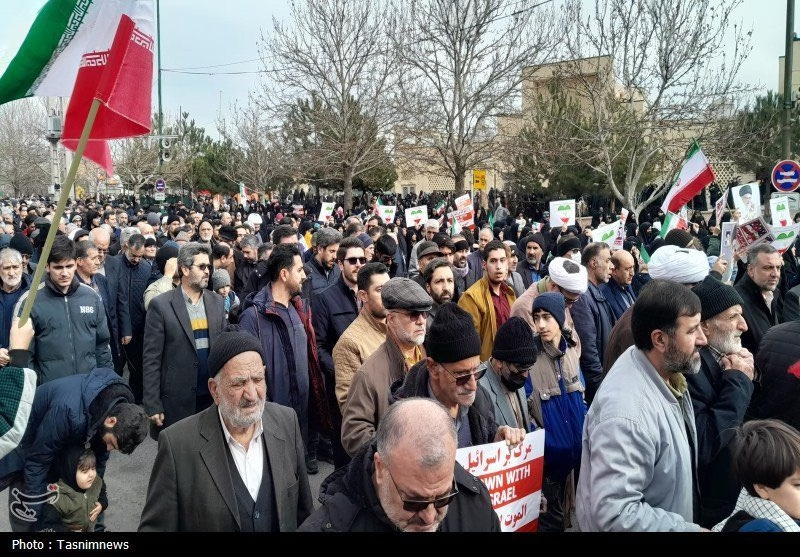
Tens of thousands of pro government supporters poured into Iran’s streets on Monday in a carefully choreographed show of loyalty to the state, following an official call for mass mobilisation. State television carried sweeping images of crowds filling Tehran’s Enghelab Square, while similar rallies were reported in Kerman, Zahedan, Birjand and other cities, all framed by authorities as spontaneous expressions of national unity rather than centrally directed demonstrations.
This is Tehran, Iran right now; Pro regime demonstrations
This is not what the US and Israel want you to see
So at night, Mossad works hard with their agents to cause chaos and during the day, they completely disappear
Zionist Pahlavi must be worried no matter how this ends pic.twitter.com/ktpMO3uni7
— Lara (@TradingLara) January 12, 2026
Iranian Foreign Minister Seyed Abbas Araghchi used the occasion to declare that the country’s internal situation was now under total control, a phrase repeated across official media. The message was clear, the state remains dominant, organised and capable of restoring order, even as images of unrest from recent weeks continue to circulate beyond Iran’s borders.
Rallies Framed As Defiance Of Foreign Enemies
State broadcasters described the demonstrations as a popular uprising against what they called American Zionist terrorism, placing the unrest firmly within Iran’s long standing narrative of foreign interference. In Shahrud, the rallies coincided with funerals for members of the security forces killed during clashes, merging public mourning with political messaging.
Supreme Leader Ali Khamenei reinforced this framing by portraying the gatherings as a warning to Washington. In remarks carried by state outlets, he urged United States politicians to halt what he described as deceitful actions and to stop relying on traitorous hirelings, language that underscored Tehran’s insistence that the unrest is being orchestrated from abroad rather than driven by domestic grievances.
Economic Shock Ignited Nationwide Unrest
The current crisis was sparked last month by a sharp depreciation of the Iranian rial alongside sweeping reforms to government subsidies. These measures immediately strained household finances, particularly among lower income communities already struggling under years of sanctions and inflation.
What began as economic protest quickly evolved into broader expressions of anger against the political system, spreading across cities and provinces. Violent confrontations between demonstrators and security forces followed, marking one of the most serious waves of unrest Iran has faced in recent years.
⚡️#BREAKING Latest pro Ayatollah protests in Iran spark debates about the reality of the situation in Iran and whether anti regime protests are as serious as some outlets report them to be pic.twitter.com/YBeUmRF6rt
— War Monitor (@WarMonitors) January 12, 2026
Government Accuses Washington Of Direct Interference
Addressing foreign diplomats on Monday, Araghchi reiterated that Iran’s leadership views the unrest through the lens of external manipulation. He claimed that protests had been deliberately turned violent to create a pretext for United States intervention under President Donald Trump.
Iran, he said, was ready for war but also for dialogue, a dual message that combined deterrence with conditional openness. He accused foreign elements of fuelling demonstrations and vowed that security forces would hunt down those responsible, while also promising the restoration of internet services that have been largely blacked out since Thursday.
Trump Signals Pressure As Tehran Pushes Back
President Trump said on Sunday that his administration was considering very strong options, including potential military action. The White House later stressed that while diplomacy remained the preferred route, force was not off the table if Iran continued its crackdown on protesters.
Trump also claimed that Tehran was seeking negotiations with Washington following his threats of retaliation, a statement Iranian officials have not directly confirmed. The exchange has added another volatile layer to an already tense regional standoff.
Rising Death Toll Fuels Global Alarm
Casualty figures remain contested and politically charged. According to Iran’s semi official Tasnim news agency, at least 111 members of the security forces have been killed during the unrest, while the government has not released official numbers for civilian deaths.
Rights groups operating outside Iran estimate that around 600 protesters have died over the past two weeks, though these figures cannot be independently verified. The lack of transparency has deepened international concern and intensified calls for accountability.
Europe Responds With Diplomatic And Political Pressure
The European Union said on Monday that it is considering additional sanctions against Iran, citing reports of casualties and the violent suppression of protests. EU officials signalled that existing measures may be expanded if the situation continues to deteriorate.
European Parliament President Roberta Metsola announced a ban on Iranian diplomats and representatives from entering Parliament premises, describing Tehran’s response to unrest as incompatible with European democratic values.
Iran Pushes Back Against European Criticism
Iran’s Foreign Ministry summoned the envoys of Britain, Germany, France and Italy after their governments voiced support for the protests. According to Tasnim, officials presented video evidence of violent acts by rioters, insisting that the events went beyond peaceful demonstrations.
The diplomats were urged to relay the footage to their foreign ministers and to retract statements backing the protests, underscoring Tehran’s determination to control both the domestic narrative and its diplomatic fallout as the crisis continues to unfold.