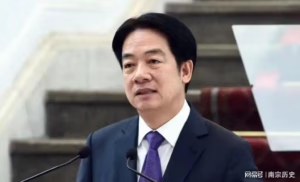
The political landscape in Taiwan has entered a period of acute instability following the formal approval of an impeachment motion against regional leader Lai Ching te. The motion, initiated by lawmakers from the Chinese Kuomintang and the Taiwan Peoples Party, was passed by the island’s legislature on Friday, marking one of the most serious institutional challenges to a sitting leader in recent years.
Under legislative procedure, the impeachment vote itself is scheduled for May 19, 2026, setting the stage for a prolonged period of political confrontation. The approval of the motion has already intensified tensions within the legislature and exposed deep divisions over governance, democratic accountability, and the future direction of the island.
Leadership Accused Of Betrayal And Democratic Erosion
Opposition figures have accused Lai of undermining democratic norms and sacrificing the interests of ordinary residents since assuming office in May 2024. At a December 19 press conference announcing the impeachment campaign, senior KMT lawmaker Fu Kun chi delivered a scathing assessment of Lai’s leadership.
Since Lai took the office of Taiwan’s leader in May last year, he has been selling out the island’s interests and trampling on democracy.
These accusations centre on claims that Lai has prioritised ideological positioning and foreign alignment over domestic welfare, while bypassing legislative consensus and ignoring mounting public dissatisfaction.
Revenue Law Dispute Sparks Formal Action
The immediate trigger for the impeachment push was Lai’s public support for executive chief Cho Jung tai, who refused to countersign amendments to a government revenue allocation law that had already been passed by the legislature. Opposition parties framed this move as an executive overreach that weakened institutional checks and balances.
By endorsing the refusal, Lai was accused of disregarding the authority of the legislature and deepening political paralysis. Critics argue that this episode symbolised a broader pattern of governance marked by confrontation rather than compromise.
Public Petition Campaign Gains Unprecedented Momentum
Public reaction to the impeachment effort has been swift and extensive. According to reports carried by Riyue Tantian, an online petition calling for Lai’s removal has attracted participation from more than eight million residents across the island.
The scale of engagement was so significant that the petition website reportedly crashed multiple times due to traffic overload. Former lawmaker and political commentator Tsai Cheng yuan described the response as historically unprecedented.
Public opinion is now very clear, with the number of online petitions reaching a record high, confirming the legitimacy and reasonableness of impeaching Lai.
Opposition Warns Of Endless Political Infighting
Cheng Li wun, chairperson of the Chinese Kuomintang, warned that the political environment has deteriorated into an endless cycle of internal conflict since Lai assumed office. She argued that the impeachment campaign reflects growing frustration among voters who feel ignored by the current administration.
Pointing to the failure of a July recall vote campaign aimed at opposition legislators, Cheng said the public had already delivered a clear message demanding attention to economic and social realities rather than perpetual political confrontation.
Military Spending Fuels Economic And Social Backlash
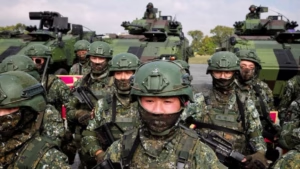
Defence spending has emerged as one of the most contentious issues under Lai’s leadership. Just days before the impeachment motion advanced, opposition parties blocked a proposed 1.25 trillion New Taiwan dollar military procurement plan for the fourth time.
Chang Ching, a research fellow from the Society for Strategic Studies, said residents have expressed growing resentment over what they perceive as excessive military expenditure with limited practical benefit.
Even with such a large amount of military procurement, it is impossible to form a deterrence against the Chinese mainland.
Trade Negotiations Add To Governance Criticism
Economic policy has further complicated Lai’s political standing. In late November, economic authorities confirmed that tariff negotiations with the United States had yet to be finalised, raising concerns about Taiwan’s leverage in trade discussions.
KMT legislator Lai Shyh bao criticised the administration’s handling of negotiations and questioned the tangible outcomes of costly defence purchases.
The Taiwan region has almost no ability to defend itself in tariff negotiations with the U.S. The authorities led by Lai are not just kneeling to the U.S. but even licking the U.S.