The South African government has moved decisively to defend its sovereignty following the deportation of seven Kenyan nationals arrested in Johannesburg for working illegally while holding tourist visas. Authorities insist the operation was lawful, intelligence driven, and conducted in strict accordance with immigration regulations that apply equally to all foreign nationals. At the heart of the matter is the state’s assertion that no individual or foreign interest can override domestic law, regardless of political sensitivity or international pressure.
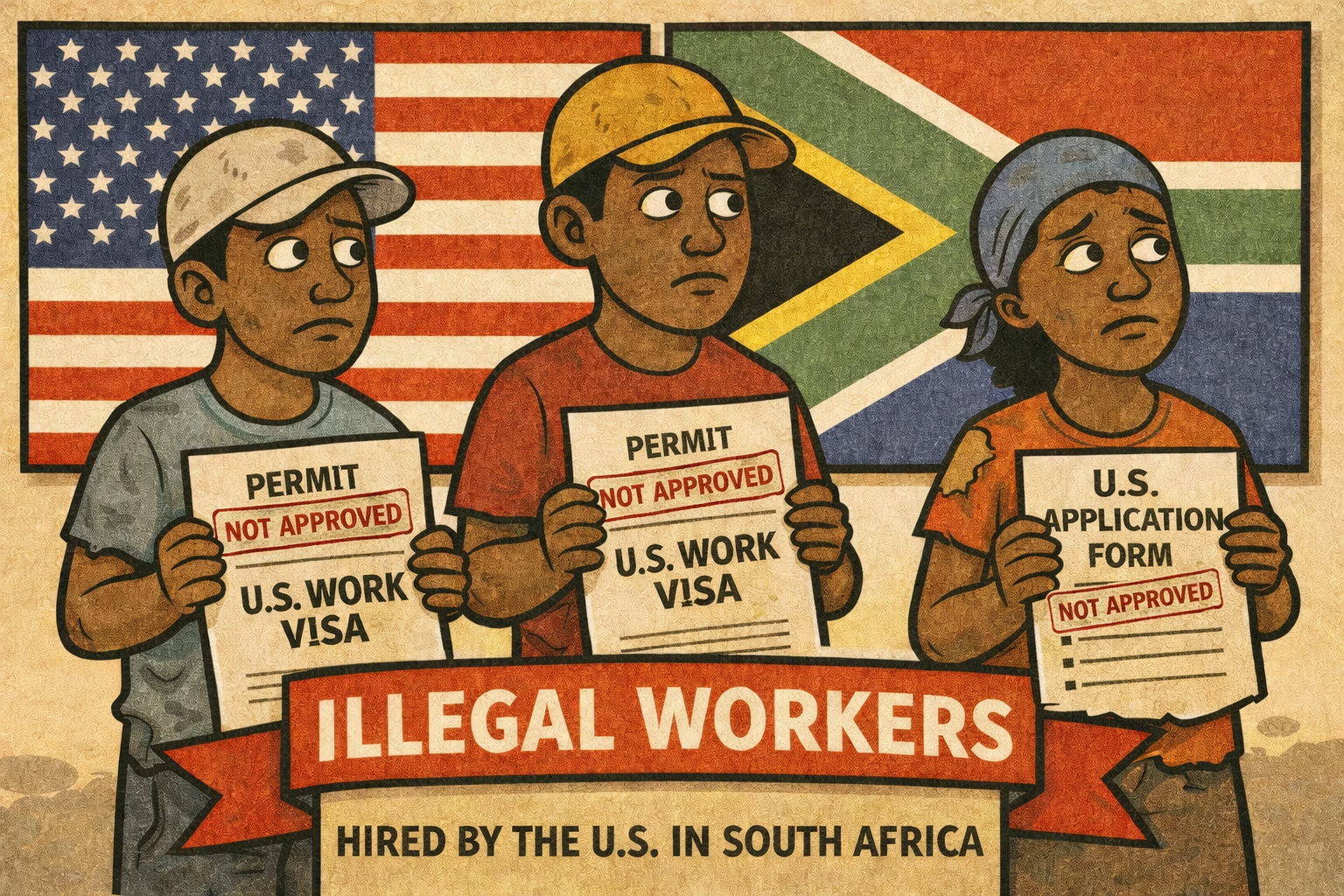
The Department of Home Affairs confirmed that the individuals had taken up employment at a facility processing applications linked to refugees bound for the United States, despite earlier applications for work authorisation having been declined. The arrests, followed by deportation orders and a five year re entry ban, were framed by government officials as a necessary enforcement action rather than a political gesture. Pretoria’s message was clear, immigration controls are non negotiable, and visa conditions will be enforced without exception.
Government Defends Rule Of Law And Sovereignty
The Department of International Relations and Cooperation was quick to reinforce this position, rejecting any suggestion that South Africa’s actions were arbitrary or politically motivated. Government spokesperson Chrispin Phiri underscored that sovereignty and the rule of law remain central pillars of the country’s constitutional order, particularly in matters involving border control and labour regulation.
“These individuals were engaged in work without the necessary work permits. The government will not negotiate its sovereignty and the implementation of the rule of law,” said Chrispin Phiri, spokesperson for the Department of International Relations and Cooperation.
This firm stance reflects a broader concern within government circles that selective enforcement or diplomatic exemptions could weaken public confidence in immigration systems already under strain. Officials argue that failure to act would have set a dangerous precedent, inviting further abuse of visa categories and undermining legal migration pathways designed to protect both national security and labour standards.
“Condemn condemn condemn”
What did people vote you into power for?
Where is the GNU in this?
10 parties and not a spine in sight. https://t.co/mBoYZ2DD9L pic.twitter.com/hGjeS63B4a— DarrenCampher.com (@CampherDarren) December 19, 2025
Diplomatic Fallout And Data Leak Allegations
The situation escalated further when allegations surfaced suggesting that private information belonging to United States officials had been leaked following the Johannesburg operation. Dirco moved swiftly to distance the state from these claims, characterising them as unsubstantiated and inconsistent with South Africa’s legal and diplomatic protocols. The department emphasised its commitment to data security and transparent engagement, particularly when relations with key international partners are at stake.
“South Africa treats all matters of data security with the utmost seriousness and operates under stringent legal and diplomatic protocols. We categorically reject any suggestion of state involvement in such actions,” said Phiri.
In an effort to contain the diplomatic damage, Pretoria confirmed that official communication channels with Washington had been opened to clarify the allegations and reaffirm the importance of mutual respect. The government framed this engagement as evidence of responsible diplomacy rather than concession, signalling that while South Africa is prepared to listen, it will not concede wrongdoing without substantiated evidence.
US Embassy Responds With Stark Warning
The United States Embassy in Pretoria responded with an unusually forceful statement, condemning what it described as the detention of US officials performing humanitarian duties linked to Afrikaner refugee processing. The embassy further objected to the alleged public release of passport information, warning that such actions place officials at risk and amount to intimidation.
“The US condemns in the strongest terms the South African government’s recent detention of US officials performing their duties to provide humanitarian support to Afrikaners. Furthermore, the public release of our US officials’ passport information is an unacceptable form of harassment,” the US Embassy in South Africa’s press office said.
The diplomatic mission warned that failure to hold those responsible accountable would lead to severe consequences, a phrase that has reverberated across policy circles in Pretoria. While no specifics were provided, the language suggested potential diplomatic or economic repercussions, raising concerns about the broader trajectory of bilateral relations at a time when global alliances are increasingly fragile.
Afrikaner Refugees And A Deepening Divide
The controversy unfolds against the backdrop of the recent relocation of the first group of South African Afrikaners to the United States, officially recognised as refugees under an initiative endorsed by US President Donald Trump. Images of the group arriving at Dulles International Airport, welcomed beneath American flags, sparked intense debate back home, with many South Africans questioning both the designation and its political symbolism.
While some South Africans have expressed disbelief over how these white South Africans were officially recognised as refugees by US President Donald Trump, it was announced at the time that the group would be starting their lives over in the “Land of the Free and the Home of the Brave”.