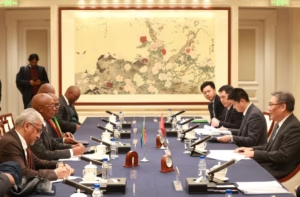
Africa’s largest bank by assets has taken a significant step in reshaping how African businesses transact with China, a move that reflects deeper shifts in global trade, finance and currency settlement. Standard Bank has become the first African financial institution to integrate directly with China’s Cross-Border Interbank Payment System, known as CIPS, allowing companies on the continent to settle payments to Chinese suppliers in Renminbi rather than routing transactions through the United States dollar.
The development carries implications well beyond banking infrastructure. It touches on trade efficiency, currency exposure, geopolitical alignment and the evolving balance of financial power between established Western systems and emerging alternatives led by China.
A Structural Change In Africa China Trade Payments
For decades, much of Africa’s trade with China has been intermediated through the United States dollar. Even when African firms were paying Chinese suppliers, transactions often passed through correspondent banks outside both regions, introducing additional settlement layers, delays and costs.
By integrating directly with CIPS, Standard Bank has removed one of those layers. Payments can now be cleared and settled directly in Renminbi, offering what the bank describes as a faster and more efficient route for cross-border transactions. This change reduces exposure to currency volatility linked to dollar movements and lowers transaction fees that accumulate through intermediary banks.
The shift is particularly relevant for African importers who rely heavily on Chinese goods. Manufacturing firms, electronics distributors and construction companies are among those expected to benefit from improved cash flow management as settlement times shorten and currency risks are more predictable.
Rising Trade Volumes Drive Demand For New Payment Routes
The timing of the move is closely tied to the scale and growth of Africa China trade. According to Standard Bank’s 2024 Trade Barometer, 34 percent of African firms now import goods from China, a notable increase from 23 percent just one year earlier. This rise reflects China’s entrenched role as a supplier of finished goods to African markets, ranging from industrial machinery to consumer electronics.
Trade volumes underscore this trend. China Africa trade reached 134 billion dollars in the first five months of 2025 alone. The flow remains largely asymmetrical, with finished products moving into African economies while raw materials such as minerals and agricultural commodities are exported to China.
As these volumes expand, inefficiencies in payment systems become more costly. Delays of even a few days can strain working capital for businesses operating on tight margins. The ability to settle transactions in near real time through CIPS addresses a practical concern that has long affected firms engaged in high-frequency cross-border trade.
How CIPS Changes The Mechanics Of Settlement
CIPS is China’s state-backed system designed to facilitate global Renminbi payments. It enables participating banks to clear and settle cross-border transactions directly, often in near real time, without relying on traditional Western-dominated payment rails.
Standard Bank secured its licence to participate in CIPS in June and has already activated the system across its digital platforms. With a presence in 21 African countries, the bank is positioned to roll out Renminbi settlement capabilities across multiple markets, offering clients a uniform payment solution tied directly to Chinese financial infrastructure.
For African companies, this means fewer intermediary banks, lower compliance friction and clearer visibility on settlement timelines. For the bank, it strengthens its role as a conduit between African markets and Asia’s largest economy.
Geopolitics And The Push For Payment Diversification
Beyond operational efficiency, the integration reflects broader geopolitical and financial trends. Around the world, governments and financial institutions are reassessing their dependence on single-currency systems, particularly those linked to the United States dollar.
Sanctions regimes, geopolitical tensions and shifts in global trade alliances have accelerated interest in diversified payment networks. China has actively promoted the international use of the Renminbi, positioning CIPS as a strategic alternative to existing global settlement systems.
Standard Bank’s move aligns with this global push for diversification. While the bank has not framed the decision as a political statement, the practical effect is to deepen Africa’s financial connectivity with China at a time when global trade financing is becoming increasingly fragmented.
Implications For African Businesses And Financial Markets
For African firms, the immediate impact is likely to be felt in transaction speed and cost predictability. Over time, wider use of Renminbi settlement could also influence pricing strategies, contract structures and currency risk management practices.
There are, however, considerations to weigh. Greater use of Renminbi exposes firms to fluctuations in China’s currency and monetary policy. Businesses will need to develop a clearer understanding of Renminbi liquidity and hedging options, particularly in markets where dollar-based instruments remain dominant.
From a financial system perspective, the move highlights Africa’s growing role in a multipolar global economy. Rather than aligning exclusively with any single financial bloc, African institutions are increasingly engaging with multiple systems to serve the practical needs of trade and investment.
Standard Bank’s direct integration with CIPS does not replace existing payment routes but adds another option to the toolkit. For a continent whose trade relationships are expanding and diversifying, that flexibility may prove as important as speed or cost savings.